Showing posts with label Kumihama bay. Show all posts

Wednesday, November 2, 2016

even farther than beyond! (7 of 8)

Ha- Kumihama -tata
our problem-free philosophy! (3)

It allegedly "means no worries for the rest of your days". Ha ha ha! Let me laugh a bit. Ha ha-Kumihama-tata, quelle chose fantastique! In case you don't have a clue what we're talking about, it's probably time for you to do the time jump and learn of our previous Helpx adventures in Kumihama with Atsushi-san and his lovely and loving family.

an in-pictures summary of our daily life by the Kumihama Bay: a breath-taking environnement and a breath-taking food experience!
We have a first episode in Engrrish for you and a second one in Fwench, well: for you too - so you get to practice a bit. Now wepeat aftew us: "mon tailleuw est wiche". Excellent! We pretty much told you everything about the work we did, helpxing an average 5-6 hours per day, in exchange of (luxury) accommodation and (amazingly delicious) full board. Believe it or not, as magnificent as life in Kumihama might be, that's not even the main reason why we spent about a month and a half at Atsushi's, while our plan was to spend 10 to 15 days there! First, it's because Atsushi-san is the nicest, friendliest and most generous person one can dream of: good communicator, straightforward and always positive, he gets out of his way all the time to make sure his guests/helpers are happy and comfortable. We sometimes had to insist to keep working a bit more and he sometimes had to insist so we stopped working at once! True thing.

the tokonoma in one of the guestrooms, with Oka-san's freshly composed ikebana.
Then, because Atsushi-san's parents, Oka-san and Oto-san, treated us with gorgeous food, with special umeboshi recipes to heal and cure all our pains and health issues (we'll talk about that in a moment...) and even with some special bootleg sake every time they found a decent-enough reason to celebrate. They also let us cook for them and we soon discovered that Atsushi, his wife Naoko-san and daughter Yuzuki-chan had a soft spot with sweets in general and with homemade cakes and cookies in particular! Young Yuzuki-chan was often very enthusiastic to play, cook, eat and practice English with us (the latter being probably not the best way for her to improve her skills, ha ha!). In a word: they all made us feel at home and a part of the family each and every day of our stay and we could never thank them enough for that! When your plan is to do Helpx for a while and you end up meeting (and belonging to) a foster home at the end of the world and you do not want to leave them - thank you Helpx for causing these and also those! Even good old Ko-Aru, the family's inu, adopted us and accepted us as a part of its dog-mestic environment (dog-mestic, ha ha!). On our free time, we could still work on some translations from our remote office, in order to keep paying for part of the whole adventure (making money along the road is an important part of our un(t)raveling philosophy). We also had time to go "surfing" or walking along the nearby beach, borrow bicycles to ride around the bay or go visit some local touristic attractions, such as the famous dairy farm whose Jersey cows are friendly and produce yummy yogurt and ice-u-curima: both tested and approved! It was actually on a sunny Sunday, right after visiting the dairy farm, that Futuna started to feel dizzy "again". "Again" because the feeling was pretty much similar to that experienced in Berlin). "I must be tired" he thought while focusing on riding his bike in a straight line along the road back home - a bicycle trip in the purest "Mr. Hofmann's style"...

the famous Tango Jersey farm and its friendly Jersey cows ; a cow'se-up shot ; tasted and approved by two lactose-(hyper)-tolerant cats!
Half an hour later in the kitchen, as he was cooking some dinner with Wallis, everything started spinning "again". He managed to run to the toilet, railing against the walls and stumbling on every piece of furniture (fortunately, Japanese rooms are generally quite empty), to throw up all he had. It was as though a potent psychedelic drug had just kicked in. Without the fun. From that moment, woosh!, Futuna vanished from the face of earth during about 4 days. Incapable to stand or sit and to keep any solid food more than 10 minutes, he spent all this time in bed, vomiting in a bucket most of the water and soup Wallis and Oka-san brought him. Ah, he also vomited bilis despite desperately repeating his Epley maneuvers so as to take the inner crystals back in resting position... But nothing seemed to work this time and there was no clue the situation would ever improve. Armed only with her clinical eye and a little help from google, Wallis soon concluded it was NOT the BBPV diagnosed in Berlin: first, because the Epley maneuvers were not working; second because the nystagmus was constant, not increasing upon head movements nor decreasing upon reclining. Bizarre...*

that's the information we got from the hospital: papers, tickets, vouchers and such...
She even got an alternative diagnosis: Vestibular neuritis. Brilliant Wallis! Meanwhile Futuna was stable-ish: throwing his stomach up but with no life-threatening condition. His dehydration was noticeable but not alarming yet and the whole thing would likely improve and disappear after 3 to 5 days of aura. The problem was Atsushi-san and his family got extremely worried. Get in their skin and imagine a couple of strangers coming from very far away and staying at your place. One of them gets sick. Unable to walk, stand or even sit. Spending 2, 3 and 4 days in bed vomiting and moaning, with no reason to believe he's going to get better - and both he and his girlfriend repeating: "It's okay, don't worry. It's gonna be fine. It's just a matter of a few days"... (let alone this particular helper is NOT being helpful at all!)

At some point, they all were seriously worried and we couldn't wait any longer for the situation to improve by itself. We had to accept their polite offer to take Futuna to the hospital. An overall 'fun' experience. Unfortunately, we all were a bit too tense to take pictures, for it would have been really cool to post some here! Emergencies, dispatch nurse, ORL department, 2 hours waiting for an "engurishu supeakingu docutoru" and finally, we were extremely lucky that our friend Atsushi-san was fluent in English and could translate the doctor's engurishu into regular English! The specialist lasted about 20 seconds to discard a BPPV (impossiburu!) after witnessing the nystagmus was constant. 1 point for Wallis! He lasted about 5 extra minutes to conclude it was either a Vestibular neuritis (most likely, because there were no hearing loss: 2 points for Wallis!) or a De Ménière syndrome, which couldn't be discarded because of the current Typhoon: a close correlation between strong atmospheric pressure perturbations and the de Ménière was apparently well described in Japan. So it was either one or the other condition, and the doctor didn't really care which it was since the outcome, prognosis and management were the same: no treatment other than symptomatic for the nausea, no life-threatening risk as long as you didn't try to walk a highline, nothing to do but rest until the crisis ended on its own...

an ear (outer, middle and inner), with the labyrinth and vestibular nerve on the upper right.
To the question "How long for complete recovery?", his answer was something like: "bigu curisisu, okay one weeku ; symputomu fade in few months ; sequelae depend the peoporu: one year, two year, foreveru." And that was it. He invited us to come back in a couple of weeks to repeat the tests and decide whether it was vestibular neuritis or de Ménière. Two weeks later, Wallis would be proved to be right: Vestibular neuritis most probably caused by a benign viral re-circulation (herpes, Epstein-Barr or some stuff like that): a common, usually unnoticed asymptomatic infection, taking advantage of some exhaustion/stress situation and weakened body defenses to get to the vestibular nerve and create a focus of inflammation. The affected nerve can either recover or be lost forever, explaining why people can either get back on their feet after only a few weeks or keep a slight uncomfort and dizziness months after the infection. At some point (up to 18 months!), the brain learns how to compensate the loss and to rebuild proper balance using the other side (the vestibular function that wasn't affected), the sight and proprioception. Over 80 % of all patients report no more sequelae after 18 months. Fair enough and no reason to worry. Just wait, rest... and see. Obviously, it challenged our travel plans including, first and not least, the project to come back from the end of the world by land along the silk road, through China, central Asia and Iran. It was just impossible to say if - and when - Futuna would be able to hike through the Asian winter with a 25+ kg backpack, without falling every 3 steps like a drunkard. The doctor insisted it was better not to fly within a few weeks (changes in pressure are generally very bad for the ears), nor to engage in any tiring activity, and to avoid unnecessary stress. Yeah!

our extended family on Oto-san's birthday (he and Oka-san are in the center) ; the yummy fish barbecue and the garage party we threw that night!
That meant longer holidays in Japan and later, well, ¡qué será, será! It took Wallis 4 more days to manage to get Futuna to sit and read books or to just stay on a chair in the sun by the bay. Brave Wallis! And from that moment, things improved pretty fast: walking without stumbling every other step, walking up and down the stairs, standing with his eyes closed and even working on a platform with the rest of the team. After a week, Futuna was back to life and almost 100 % back to normal! Weaker, slower and clumsier than ever, but alive and kicking. Oto-san's special diet of "eat this!", "now eat that!" sure helped this super fast recovery. And that's exactly when Atsushi's brother came with a bunch of friends and colleagues from Fukuoka, to chill over a weekend and celebrate Oto-san's birthday. So, we had a great barbecue night with them all: good time, lovely food, fun conversations - especially about blood types**. We also took 1.000 selfies and FB-friended so as to get in touch and hang out when we'd visit Fukuoka. After Shimon-chan, our agenda for Fukuoka was getting full of promises, ha ha! Lovely Nao-san even offered to give us a proper surfing lesson, but Futuna was not exactly in the mood yet and that would have to wait... With the prudence and pace of a centennial, we kept working another couple of weeks after that, getting back to normal and thinking of options for the rest of our un-travel. Meanwhile, Wallis' mother was randomly seeing a documentary on TV from Barcelona, about a remote and un-touristy Japanese island. She immediately sent us an email, advising us to go see this tiny, beautiful and raw little volcanic wart covered in transitional primary rainforest, home of trees over 3.000 years old. This place, its one-of-its-kind virgin forest and biodiversity were said to have inspired the landscapes of Miyazaki's "Mononoke hime".

the small temple/shrine by the pinetree on the hill, and its little shinto cairns.
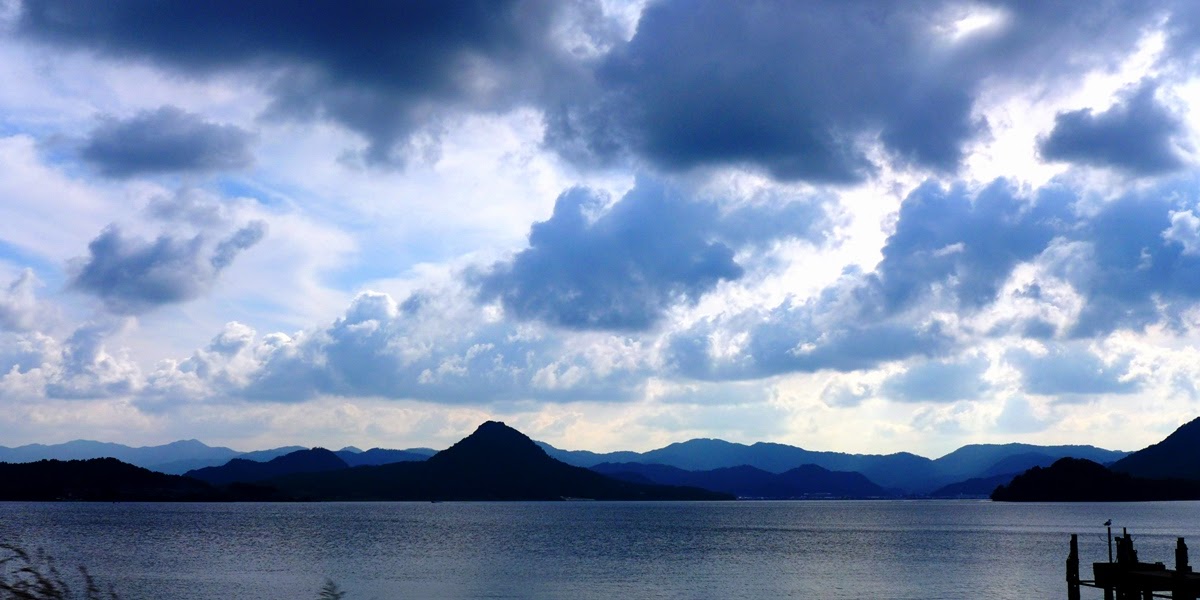
At a time when all projects were to be re-designed and all dreams re-dreamt, we put the mysterious island on our bucket list and insh'Allah, you'll hear more about it within a few weeks! We kept working on the platforms, cooking and having fun together, went to see some matsuri (traditional festivals, pictures coming...) in the surrounding villages and Oto-san decided, as a farewell treat, to take us on a hike to the summit of the nice little mountain we'd been looking at all this time, just across the bay. We visited the little temple halfway up the gentle slope and took a long while enjoying the beautiful views. The opening picture on this post is from up there! The next morning, after a last breakfast even nicer than the others and a long and emotional round of (western-style) hugs, Atsushi-san and Pei-chan** drove us to the local train station so we could start our long pilgrimage around Kyotango peninsula and all the way to Amanohashidate, then to Kyoto for the world-famous Jidai Matsuri. And from there, sounthbound to Kyushu island: Fukuoka, Kumamoto, Kagoshima, Nagasaki and farther... So, that's pretty much it for today, but you can follow us and keep up with our latest adventures!

last impression matters: Atsushi-san and Pei-chan goodbye as a zombie-attack!
By the way, did you know you could subscribe to our blog? There's a small box on the right side of the page, at about the height of the friendly cow, where you can enter your email address and get each new post, freshly delivered to your mailbox within 24 hours... Well, now you do, et voilà: let's take the wendez-vous and never miss a new release!

Okay, our train is leaving, it's time for us to say goodbye. But not without (once more!!) extending our warmest thanks and sending much love to Atsushi-san and his wonderful family. We are so grateful, happy and honoured that you adopted us, took care of us and shared your daily life in beautiful Kumihama with us! Our home will always be your home, wherever it is and whenever you may come visit us.

Atsushi-san, Naoko-san, Oka-san, Oto-san and Yuzuki-chan, take great care and see you again someday! 


Take care
and see you soon!
Love to all,
W. & F.


___________________________


If it took Wallis less than 1 hour to conclude this crisis wasn't BBPV, it took her much longer to forgive the young emergency's intern who first diagnosed BPPV at the hospital in Berlin: it most probably WASN'T BBPV back then, since the nystagmus WAS stable, constant and unaffected by head movements... Moreover, even though it COULD happen, it's very unlikely that Futuna suffered a BBPV (idiopathic) in July and a Vestibular Neuritis (infectious) in October, on the same ear! It is possible, though, that the viral infection wasn't complete in Berlin (the crisis lasted about 4 days and the Epley maneuvers maybe coincided with spontaneous recovery) and hit back a few months later upon a stress or heavy fatigue...


** About the blood types: we were unsure at first whether it was a joke, but apparently the Japanese culture connects the 4 blood types (A, B, AB and O) with  psychological profiles and even lifestyles. Somehow comparable to our astrological signs, blood types are a smooth way to start a conversation or flirt: "I was sure you were a B-type too, that's why we connected immediately!", "Are you kidding? How can you be an A? Usually I can't work with A's!", "Oh, you're right: Kento is sooo AB! Reminds me of me mom!", "I could sense there were an O-girl in the room, but I wouldn't have imagined it would be as gorgeous as you are..." and so on, for hours... ;)


just because it didn't match anywhere else: "good mornin' little school bus" !


Tuesday, October 25, 2016

encore plus loin qu'au-delà... (6 sur 8)

Ha- Kumihama -tata (2)
quelle chose fantastique!


qui n'a jamais rêvé de travailler avec une... pon-star ?
Pour notre jamais-deux-sans-troisième Helpx de ce non-voyage-jusqu'au-bout-du-monde-et-au-delà, on avait établi le contact depuis quelques mois (avant même le départ - et oui, des fois il nous tombe un œil et on s'organise; même qu'on s'y prend à l'avance et tout. C'est dingue!) avec Atsushi-san, qui tenait une ferme ostréicole à environ 3 heures de Kyoto, à l'extrême nord de la province, juste à la limite occidentale de la (très belle et injustement méconnue des touristes gaijin) péninsule de Kyotango. - On y ferait d'ailleurs prochainement une escapade d'une journée au fil des lignes de trains et cars locaux, entre villages de pêcheurs le long des golfes pas si clairs et villages de pêcheurs sertis entre les ardoises sombres de falaises déchirées. On mettra un lien dès que le topo de notre périple sera en ligne! - Mais revenons à nos moutons... L'auberge familiale et la ferme ostréicole d'Atsushi-san et sa famille sont posées sur une étroite langue de terre qui sépare la baie de Kumihama de l'océan : un coin de paradis à la beauté paisible, sauvage et extraordinaire. On raconte nos premières aventures et nos premières journées avec Atsushi-san, ses parents Oto-san et Oka-san, sa femme  Naoko-san et leur fillette de 7 ans, Yuzuki, dans l'épisode antérieur (en images et en anglais). Alors, en résumé pour les plus pressés : on a consacré nos premiers jours à (regarder ses amis) réparer un ponton endommagé par les typhons de l'été, Mais on a aussi restauré, rafraîchi, ordonné et réorganisé un peu son Oysta' Garage, un cabanon rouillé assez funky qui n'était pas sans rappeler une tanière de célibataire ou le dernier bastion d'intimité d'un family guy quarantenaire : planches de surf, outils, tables et chaises de camping, vieilles machines cassées, glacières-bancs, matériel de pêche q.s.p. monter un club ou une école, ainsi que divers objets d'autant plus insolites que l'on risquait une main gantée dans les profondeurs de l'improbable amoncellement... Pour le reste, on était logés luxueusement et très confortablement dans une chambre traditionnelle (papier de riz au mur, tatamis de paille de riz au sol) meublée de nos deux futons à dérouler chaque soir et enrouler chaque matin et d'une grande table basse servant à tout. La salle de bain typique avec douche et ofuro* était commune à tous les helpxers, nous l'avons donc partagée quelques jours avec R. au début, avant qu'il s'en aille trouver la voie ailleurs. Puis avec l'adorable Pei-chan, jeune graphiste et illustratrice Singapourienne en vacances au Japon pour le mois. Si la cuisine était partagée par toute la famille et les helpxers, elle n'en était pas moins le domaine sur lequel régnaient sans partage mais avec mansuétude Oto-san et Oka-san (un peu dans le style Booz, il faut dire). Arriver à nous y faire une place et à y importer quelques recettes méditerranéennes, tout en observant, respectant et apprenant les règles du jeu et celles du lieu, a été un défi et un vrai petit plaisir de chaque jour. Comme à la maison. Ou chez mémé.

c'est téléphoné mais: sous la plate-forme immergés, coquillages et crustacés...
Durant la semaine qu'on a partagée avec Atsushi-san et Pei-chan, le travail quotidien était 100 % ostréi- et conchyli-cole. Cela consistait essentiellement à changer les boîtes des coques (cockles) : une fois par mois environ, il faut donc remonter à la main les grands bacs pendus à des cordes sous les plates-formes, entre 2 et 3 mètres de profondeur, puis les hisser sur la plate-forme pour pouvoir les vider de leur eau, rincer le substrat minéral (sable et charbon) qu'ils contiennent et bien sûr, trier et compter les coques au passage. Les bacs sont pendus en lignes directement sur la structure en bambou des plates-formes, sont lourds sous l'eau et extrêmement lourds une fois hors de l'eau (maudits soient Archimède et son invraisemblable théorie!), les cordes sont mouillées et couvertes de bébés moules et autres mollusques à bords tranchants, la houle légère qui ride la baie fait danser les plates-formes et les mats de bambou sont glissants. En un mot, c'est un travail qui fait payer un lourd tribut aux lombaires, mais qui est dans l'ensemble agréable, jamais ennuyeux, souvent rigolo et au cours duquel il faut s'efforcer de ne pas glisser, trébucher ni perdre l'équilibre sous peine de libérer l'outil de travail et le capital immobilisé dans l'eau trouble de la baie. Autre tache amusante et cruciale lors du changement de boîtes : repérer et éliminer le petit crabe rouge qui aurait pu réussir à passer entre les mailles de filets métalliques couvrant chaque bac. Pour ce prédateur gourmet et opiniâtre des (pauvres) coques (sans défense), se faire emprisonner dans un bac tout frais changé correspond ni plus ni moins à un mois de vacances-récompense-au-palais pour quelque Hashshashin : fontaines de lait et de miel, dattes, raisin, herbe-qui-rend-nigaud, musiciennes, danseuses du ventre... Oups, je m'égare. Deux conclusions personnelles sur ce point en particulier? Allez, d'accord, mais c'est parce que c'est vous :
1- ouvrir un bac contenant un crabe et sauver 3 ou 4 coques parmi la trentaine de dépouilles vides est TRÈS triste.
2- le crabe se cache TOUJOURS dans l'une de ces dépouilles de coquillage - la dernière ajoutée à la funeste liste de son menu du mois écoulé : "Ah tiens, mais vous êtes là? Eh ben, vous pouvez débarrasser, du coup. Beuurp. Merci!"

la preuve que le boulot nous plaît (et qu'on est  très bien nourris!): (1) sourire avant d'y aller ; en équilibre sur un support rond, flottant  et mouillé?
(2) centre de gravité bas et pieds nus, ou (3) leçon de surf  improvisée? ; (4) et sourire au retour, malgré le crachin!

Alors bien sûr, si on peut faire 2 équipes de 2 et se répartir les taches, c'est moins pénible et ça va assez vite. Si je tire les cordes et sors les boîtes, Wallis prépare les boîtes propres à côté. On tamise plusieurs bacs dans l'épuisette et on rince les substrats avant de les transvaser, puis on prend les coques de cinq en cinq, en choisissant des tailles variées dans chaque bac et en écartant celles qui sont vides ou mortes. Puis il faut remplir la caisse d'eau, mettre les grilles et - LE point délicat et qui était la grande spécialité de Wallis - refaire le nœud qui attache la caisse à la plate-forme avant de la remettre à l'eau délicatement. En 2 semaines de boulot, on a perdu en tout et pour tout 1 (UNE) caisse, suite à petit malentendu du style "mais je pensais que tu avais fait le nœud / mais je t'avais bien dit toutes sauf la dernière"...

Wallis en plein nettoyage des caisses usagées : parfum vieille marée garanti!
Et Dieu sait qu'on se sentait mal en regardant le bac s'enfoncer lentement et disparaître dans les profondeurs (assez modestes apparemment) de la baie. Bon, au final une plate-forme prend la matinée et le début d'après-midi si on bosse bien et ça laisse plein de temps après pour l'autre tache passionnante (cette fois c'est ironique) de cette noble activité : le lavage des bacs. Au karcher tout d'abord - et c'est la promesse de multitudes de fragments de mollusques bivalves dans les cheveux, dans la bouche et dans les yeux, en dépit de tous les EPIs possibles et imaginables. À sec, à la spatule ensuite - et c'est la garantie d'une indélébile odeur de vieille moule (pardon!) sur les doigts et sous les ongles, réfractaire à tous les savons connus et reconnus... Une fois le lavage/raclage fini, on passe un coup de karcher sur le ponton fraîchement réparé et on a mérité le petit grand moment-plaisir de l'après-midi, la pause Kit-Kat conchylicole, la petite faiblesse qui nous perdra : le lavage à pression qui masse le dos et les fesses et fait des chatouilles sous les bras et fait vibrer la toile du ciré avec un bruit de vieille machine à laver ou de cordages de dériveur dans le vent. Flpflpflpflpflp! Ces journées intenses mais plutôt courtes nous laissaient encore pas mal de temps pour d'autres activités plus - disons - créatives, avant la douche et le dîner. Dans la lignée de la cure de jouvence de l'Oysta' Garage, on a pu récupérer et (= on nous a laissé = on a eu la gentillesse de ne pas nous interdire de) bricoler avec tout un tas de bois de charpente, de palettes et de décombres d'un bistrot de plage depuis longtemps abandonné aux crabes, aux mouettes et aux araignées... un Futuna paradisio!

au travail dans le crachin et avec le sourire ; nettoyage du ponton et enfin, la récompense : une douche-massage à pression!

Bon. Nous, on voulait surtout mettre de l'ordre et trouver un système de rangement en extérieur pour tous les filets, casier, grilles, nasses et cordages dont Atsushi-san alternait l'utilisation au gré des saisons et des phases de production. Autour d'un nescafé fumant à l'heure du goûter, on a donc imaginé avec Wallis et Pei-chan, de grosses étagères bien robustes. On a opté pour des profils en A qui sont auto-portants, stables et très faciles à fabriquer. On les a taillés dans de vieux chevrons et assemblés avec des tiges filetées récupérées par là. Une fois les 2 profils installés et unis, on les a garnis avec des étagères et des barres sur mesure pour recevoir les différents trucs et machins à y stocker. On en a fait 3 en tout, qu'on a posées sur le ponton de part et d'autre de l'Oysta' Garage, juste contre le mur de jetée. Atsushi-san avait aussi besoin d'une espèce de paravent ou de panneau mobile pour protéger la zone de nettoyage des huîtres devant le garage, des embruns glacés du début de l'hiver. Avec pas grand-chose de plus qu'une scie circulaire et des vis recyclées, on lui a donc fait deux écrans relativement stables (faudra pas les laisser sur le ponton, face à des rafales à 90 km /h, par contre) et faciles à déplacer. Et finalement, une fin d'après-midi où la lumière était magnifique et invitait au farniente, on a quand même pris une petite heure pour assembler des chutes de palettes autour d'un vieux volet qui avait servi de fond pour peindre au spray un cadre ou quelques chose comme ça. Quelques cm de tige filetée et une douzaine de clous plus tard, on avait une jolie table basse très Pinterest pour s'inventer un coin apéro de 19h ou infusion de 22. Avec le soleil qui descend entre les montagnes sur la baie.

la jetée avant, pendant et après, avec l'étagère finie et chargée ; la même chose de l'autre côté du hangar... et deux pièces uniques de plus!
les tés assemblés à la scie circulaire et  un écran terminé ; inspiration de fin de journée, la table basse récup' pour coin apéro-contemplatif.

Avec tout ce travail et les heures passées en cuisine, à bavarder, rire et apprendre, il y a aussi eu des journées libres. Pour aller surfer (enfin, emmener la planche en promenade et se râper les genoux à tour de rôle dans des mini-rouleaux de Club Mickey, mais bon, faut un début à tout!), pour faire le tour de la baie en vélo ou pour aller faire la tournée des matsuri (insérer lien plus tard!), ces festivals qui célèbrent dans les rues de chaque village le cycle des saisons, les solstices et équinoxes, la fin de la récolte du riz, en rendant hommage à tout un tas de divinités, parmi lesquels Hinari, notre renarde préférée qui apparemment à son grain de sel à mettre dans l'abondance des moissons... On tachera de faire un ou deux posts avec au moins des photos, vu qu'on serait bien emm---és s'il fallait vous expliquer de quoi il s'agit, qu'est ce qui symbolise quoi, ou les paroles des chansons! On a aussi connu le très attachant Shimon-chan, jeune australien d'origine japonaise, arrivé quelques jours avant notre départ. Il était drôle, curieux de tout, cultivé... et millenial : toute une synthèse charmante et harmonieuse de plein de cultures assez distinctes. Bref, on a bien accroché et sympathisé. Mais on vous reparlera certainement de lui plus tard, puisqu'on a prévu de se revoir. Le plan est d'explorer un peu ensemble Fukuoka** et les environs, car il a prévu de rendre visite à sa grand-mère le mois prochain. Sinon, Futuna a aussi eu des soucis de santé, apparemment sans gravité mais assez impressionnants. Une espèce de "Vertiges II, le retour" : la suite de ses indispositions et pertes d'équilibre berlinoises, mais en pire. Vraiment pire! On vous racontera très bientôt, dès qu'on en saura plus et que ça ira mieux... Pour l'instant, pas d'inquiétudes, tout tourne!! baigne et on a la situation en main. Plus ou moins. Et c'est tout pour aujourd'hui! On vous laisse avec deux images façon carte postale pour se dire au revoir :

1- nos premiers pas (de surfeurs) en forme de cliché officiel : côte à côte, main dans la main, regards vers l'horizon.
2- un stage de parapente! bon, c'était pas nous mais, apparemment, y'avait grave du thermique au pied de la dune, coco!


Prenez soin de vous,
bises et à bientôt!
F. & W.


___________________________


Wallis à l'ofuro : on appréciera son expression de satisfaction absolue et son teint rose !
À propos de l'ofuro : il s'agit d'un bain (très) chaud. et typique qu'on trouve dans les salles de bains traditionnelles qui, en 4 mètres carrés, offrent l'essence du sentou ou de l'onsen : l'hygiène-détente-vapeur! Fait pour être allongé avec le couvercle plus ou moins refermé (cf. Wallis qui est dedans jusqu'au cou). L'ofuro contient de l'eau chaude et propre que l'on ne vidange pas après usage et que l'on change une fois par semaine ou tous les dix jours. Elle est la même pour toute la famille et on ne doit donc absolument PAS s'y laver. Il y a la douche, juste à côté, pour ça. Non mais! Après s'être soigneusement douché, récuré, savonné et rincé, on peut s'y glisser quelques minutes pour emmagasiner de la chaleur (les maisons japonaises ne sont pas super bien isolées) et préparer le corps et l'esprit à aller au lit. Le jour où on vide l'ofuro, l'eau sert généralement, via un circuit spécial, pour la machine à laver le linge. Super idée et super habitude, qu'on aimerait rapporter en Ariège.


**  À propos de Fukuoka : c'est une (grande) ville tout au nord de Kyushu, l'île la plus au sud, où l'on a prévu de passer le prochain mois à explorer, camper, randonner et même aller chasser une île inconnue... Mais chuuut, on vous en parlera en temps utile et en détails!


Saturday, October 22, 2016

even farther than beyond! (5 of 8)

Ha- Kumihama -tata
what a wonderful place! (1)

It means no worries for the rest of your days. Ha- Kumihama -tata! It's our problem-free philosophy. Etc. You know the lyrics pretty well, no need to waste more time on this. Sing it along until you feel dizzy but please don't stop reading.

in the background, between the Kumihama bay and the sea: the hamlet of Sh.
Leaving Nagano and the Japanese Alps after an intense and somehow disturbing two-week Helpx (see the previous chapter in Spanish if you're interested - and remember the small flags at the bottom of the page are here to provide you with an automatic and often quite poetic machine-translation of all our contents from English, Spanish and French into French, Spanish and/or English! Give it a try: it's as entertaining as walking half-drunk through a wax museum or having a serious conversation with your friend skipping all vowels and using only consonnants: it's quite fun, it's perfectly doable, it's a bit weird and it's generally free...). Anyway, with the rain pouring over the past two weeks, most of the landscape along the train trip was flooded, the rivers out of their beds and the rice fields, covered in mud like hippies in Woodstock*. We had a short stop in Kyoto before catching one of the only "limited express" trains of our stay in Japan. We remember thinking "wow! what a fancy train!". Then, it all went very fast: after about ten-to-fifteen minutes (just long enough to ride through the outskirts of Kyoto), the controller came to check our tickets, which we handed with a smile. He then asked for the limited express extra fee voucher, which we obviously didn't have (because we didn't know there had to be one). He kindly asked us to pay for the extra amount for the two of us, which was substantially higher than the total amount of cash we carried with us. We waved our credit card with implorant smiles, only to be showed some signs in bold letters "limited exupuressu voucheru mandatory" "onuly cashu on turainu" "no cureditu carudo" and "fureeloaders willu be pubuliculy shamed and kickedu outo". It was like the "no stairway to heaven" scene in that alltime classic movie.
just one of these fancy, anime, neo-classic, steampunk-inspired limited express trains
And so it happened: we got publicly shamed and kicked out at the next stop. While Wallis waited on the platform, mumbling something like "I knew it, I told you so, I saw it coming" in at least four languages, Futuna went to the station lobby in search for an ATM and came back with cash (just in case) and two coffees with milk from the closest seven-eleven: a magic balm to sweep all pain from the face of Earth... We let our Helpx host, Atsushi-san, know that we'd be there a bit later than scheduled and soon got on the next regular northbound train. We waited for a connexion somewhere,  most probably Fukuchiyama, noticing the inquisite looks of "how did those two gaijin get lost enough to end up here?" while trying to blend in... We got on the local train #Istoppedcountingthemlongago, enjoyed the ride and soon disembarked on the platform in Toyooka's station. There, we met Atsushi-san and his daugther, the lovely Yuzuki, who were waiting for us. And as the day was fading over the rice paddy fields, we drove back to their place, but not without a stop at the supermarket so our hosts could buy (for us!) all kind of western delikatessen: softbread, Nescafé, milk... and bentos for our first lunches! We'd soon discover the bentos and Western food were "just in case" we wouldn't eat local but ended up enjoying each and every day, the best possible homemade Japanese cuisine!

courtyard side: never has a soundtrack been more accurate: sitting on the dock of the (Kumihama) bay!
garden side: just a 100 meters from here in the opposite direction, magic and infinite, the ocean!

Despite our efforts to take responsibility on our subsistance and meal-cooking, Atsushi's parents - Oto-san and Oka-san - couldn't help spending hours daily to prepare the most incredible, beautiful, tasty and healthy food! Each single meal, from the first breakfast to the last dinner, was worth a Michelin star and an Instagram award-winning picture! And we'll let you imagine how embarrassing it must be to wake up at 5am, silently making your way to the toilet downstairs in the dark, only to find Oto-san in the kitchen stir-frying vegetable tempura and slicing fresh fish he'd just fished, setting it all on tiny plates with rolled omelet, umeboshi and pickled onion and daikon so we'd find it ready for our breakfast at 7 sharp. Life at Atsushi's by the Kumihama bay was, since the very first minute, like living in a dream. A top-of-the-list Helpx experience that could only be challenged by our unforgetable stay in the Ariège at dear L. & R.'s, while un(t)raveling around in the TRANSITion!, back in 2014 - when we were young and fearless, ha ha ha.

the local food chain: straight from the bay to the boat ; from the boat to the kitchen ; from the kitchen to our breakfast table!
That's the first big deal with Helpx: from one day to the next, without any previous contact (if you except the emails and/or the exceptional skype conversation) you find yourself working, chilling, eating, sleeping and sharing hours of time everyday, while living at - and within - a family of complete strangers. Hopefully, if things go well, they won't be strangers for long. But, you know, in your own country, with your own cultural codes and tacit rules, it's already quite a challenge. Now imagine doing this in a far away culture living on an island, whose language half your party barely understands like a 5 y-o does, with nothing but Engrrish to communicate. Well, landing at Atsushi's was the smoothest, nicest and hom-iest one can dream of. In the few emails we exchanged before actually getting there, we spoke of helping with the oyster and cockle farms, at the platforms on the bay, as well as giving a hand at fixing the dock and its cabin, both damaged by the recent typhoons. We were super curious about the former and super enthusiastic about the latter, so the perspective to get up at 07:00 and start the working day at 08:30 was just great. We were given a (full) traditional room with rice paper walls and rice straw tatami floor, in the old part of this still guesthouse, that had been a family-run hotel for decades.

1- enlarging the concrete posts/stakes inside some old PVC pipes ; 2- replacing and fastening the main beams ;
3- checking it's all even-ish and preparing the slat flooring ; 4- end of the second day, we'll finish tomorrow!
Our first job was to help fix (understand: rebuild) the peer/deck/dock damaged after the last typhoons. A bunch of Atsushi's friends were around to take care of the job and there was relatively little we could actually do by ourselves. Not decided to follow our "senior" Helpxer's** advice to just sit and wait for the dinner, we asked for something we could do and were given the cool task to renew the Oysta' Garage, a funky old little shack used to store all kind of oyster gear, tools, surfboards, life-jackets, plastic boxes, trays, buoys, broken down engines, stuff and such. Only rule for the job: id has to be cheap, upcycling and recycling as much as possible, being creative and solving problems with what could be salvaged around! Futuna could never had dreamt of anything cooler than that! So first of all, we emptied and dismantled the whole thing, removing the rusty/rotten pieces and taking great care to ask Atsushi-san, for each and every single found item/artifact "Astushi-san, can we throw this away, kudasai? When we were done the first night, it was looking like that (upper right pic). The next day, we pretty much face-lifted it with new sheets of galvanized steel, set some shelving inside and left a good pile of random stuff everywhere around, "to be sorted over the next few days... By the end of the second day, it looked like that (third lower pic).

working on, inside and around the funky old little shack, doing our best to give him this fresh look back again. And the night comes on...

(interlude)
And the night came on, it was very calm. 
I wanted the night to go on and on.
But she said, Go back to the World.
(end of the interlude)


After these first few days, we finally got to take the boat to the oyster farm's platforms on the bay, but that would take us way too far and too long for this first post, so we'll save it for the next one... which is coming soon, we promise. For now, let's ring the That's all folks! and we'll leave you with just a few more pictures to share the beauty, serenity and peace of this tiny little place on earth. Water, light, clouds, moutains, trees, wildlife and... a golf course in the distance! An amazing gift for the eye and the soul, every hour of the day : just Kumiha-magic!

the daily life of our heron neighbours : when there is a fish, there is a way ; stormy weather, silent contemplation and a bad moon rising...


Take care
and see you soon!
Love,
W. & F.


___________________________


* About the typhoons, the rain and the flooded valleys of the Japanese Alps: here's a picture taken from the train, somewhere between Nagano and Nagoya on the day we traveled to Tokyo. The forest was literally sweating moist, its head in the fog, its feet in the river roaring out of control, carrying mud and trees... if we couldn't see herds of tanukis floating and flowing down to the sea, it's probably because we fell asleep and failed to spot them, not for any other reason!


** About R. Dush (yes, Dush. I changed a letter to preserve his privacy and avoid getting sued), our co-Helpxer. He'd deserve at least a post just for him - which I do not exclude to write someday... When we first met him, we both saw nothing but an old TEENAGER in the classic Grunge outfit: dirty jeans, timberman shirt and curly hair down to his shoulders. While talking to him - better said "while listening to his travel adventures and little pearls of wisdom", we got to correct his estimated age-range from "early TWENTIES" to "early THIRTIES", only to later discover he was (much) older than that. Nothing in his whole person could have made you consider he was a grown-up, though. Not his attitude, nor his empathetic abilities, nor his tolerance, nor his dispositions to understand or adapt to another culture, nor his curiosity about others in general. Well, most of him was sticking firmly to what his "values" were, especially when they implied him doing nothing and looking how the Universe provided for him. Anyway, he happened to be the proud author of a "best-selling" book about a so-called "spring of eternal youth" he'd discovered through a 10-year "extensive research" in the "field of health and aging", taking him on "a journey to be forever young". Excuse the quote marks. The dude was actually in his mid-FIFTIES and not only looked like a teenager, he also totally thought and restlessly behaved like one! We had quite some interesting argu-versations on such varied topics as "homeopathy", "vaccines", "cattle breeding", "the immune system" or "created diseases", on which his "10+ years extensive research" gave him impressive knowledge and insights**... Fascinating! Stay young forever, R. Dush! Refuse to grow! Keep rocking! The sky is the limit! Wooooo!


** Absolute sarcasm intended here, everybody (but him) would probably have understood this! ;)