Showing posts with label 20 francs le kilo. Show all posts

Sunday, October 30, 2016

day-trippin' around Kyotango

Upon leaving Kumihama and Atsushi-san's family (on our way to Kyoto's famous fall festival, the gorgeous Jidai Matsuri, aka Festival of the Ages) and before heading South to Fukuoka to explore Kyushu island), we decided to take an extra day on our -tight- schedule to go on a trip around the whole Kyotango peninsula. It was supposedly a lovely area and a fun thing to do, we wanted to see the wilderness of the coastline and were lured by some famous sightseeings and local (rocky!) curiosities...
about to get on one of Japan's many groovy, vintage or retro-looking, local trains!
Wallis also wanted Futuna to see Amanohashidate, the bridge in the sky, or the dragon in the sea: a three-kilometer long, narrow strip of sand covered in pine trees jumping across the Miyazu bay. The dragon's bridge sitting on the dock of the sky is allegedly one of Japan's three (or was it five?) most iconic views, many many many people embark on a round-trip from Kyoto just to see (sorry!) take a picture (oops!) make a selfie with it in the background... Here is, then, a practical and factual - or so do we hope - report with all the information you need and a bit of inspiration to take this nice 1- or 2-day excursion as we did, or differently! We especially recommend it for the Kumihama Helpxers and AirBnb guests who'd like to see around without a car. There are several direct train options to get to Amanohashidate and the famous Nariai-ji temple, but provided you have the time (and don't mind spending hours contemplating beautiful landscapes with nothing more to do than just exactly this), the full trip around Kyotango is not only worth it: it also has material for your eyes to be extended to a 2- or even 3-day trip, sleeping anywhere along the way or reaching Fukuchiyama. Okay, enough introduction, let's get to the point and start the adventure:

1. from Kumihama or Shotenkyo stations:
 (maybe Atsushi-san will be able to drop you there, or you can (hitch-)hike there or ride and lock the bicycles at the station until you come back - getting on the train and buses with your bikes might be possible and fun, but I wouldn't try that before checking AND making sure it's allowed. Anyway, take an early Kyotango local train bound to Amino and change there for a local bus to Tate Iwa (= “standing rock”). Walk straight off the station and you'll find a bus stop immediately on your left. The waiting time is about 20 minutes and there are several buses, so before jumping on one, check with the driver it’s actually bound to Tate Iwa. The trip to Tate Iwa is quiet and you'll spend most of your time looking at the coast throughout the window.

Tate Iwa, aka the standing rock: panoramically yours ; with a happy, hippie and grassy foreground ; from a distance ; with the desert island mode on.
2. Tate Iwa standing rock: as the driver should remember your question, you're pretty sure not to miss the stop, but it's a tiny village by the sea and you wouldn't imagine that's where you're headed! The interest is on the beach, East of the village. A beautiful and picturesque basaltic rock formation, surrounded by more cliffs and raw beaches. On each side of the little bridge, you'll find some (open) bathrooms and a campsite just minutes from the rock, which could work great for a night as long as you have minimum camping gear. There's mosquitoes and not much more, but the place is nice and clean enough. Well, "clean" must depend on the weather and currents, because that day, the beach wore a thin layer of plastic and fishing trash marking the highest tide. Just at the bus stop is a restaurant (could be a hotel too?) but it was closed the day we were there. Buses pass every hour-and-a-half or so, so you'd better check it upon arrival and make sure not to miss the one you intend to hop on!

the super-busy Kyotango local bus: pick a seat and enjoy the ride ; the issue is NOT with monkeys but with wasps! ; our bus at its un-bus-stop. 


3. Kyogamisaki lighthouse: from Tate Iwa, it's difficult to get lost as you'll follow the same bus line until the terminus, that is: the Kyogamisaki lighthouse itself! Facing uphill from the bus stop, take the only secondary road (on the left) at the corner of a dirt car park. You'll walk about 1,4 km (less than a mile) up and down along this road to the viewpoint and lighthouse. You may be passed by some cars and coaches, be careful and make yourself seen because the road is narrow and some curves sharp. Except for the trails going to the lighthouse and to a higher viewpoint, there is honestly not much to do there. Again: it'll satisfy the contemplative ones.

the ragged coast and open sea from the lighthouse viewpoint. end of the road!
This said, the coast is beautiful and wild, the air fresh and the next bus is one-and-a-half to two hours later. Check it upon arrival and again, don't miss it. You'll have a chance to hitch-hike, but it could make the trip much longer... If you've taken food with you, it's time for a snack. Else, it's time to pity yourselves. We hid our backpacks in the bushes by the bus stop so we wouldn't have to carry them around, but if you take them with you, a bivouac night at the viewpoint or close to the lighthouse could be nice and nobody should ever bother you... Your bus will be waiting on the other side of the road almost one hour before the schedule, but they won't let you on anyway, as you're supposed to get on at the actual bus stop, on your side of the road and at the exact time. As a general rule, don't try and get off the established procedures in Japan, neither because you think your point is logical or fair, nor because you think it's just easier your way! Westerners sometimes have a (probably well-earned) reputation of compulsive trespassers and one of the most famous kotowazas (諺) says deru kugi wa utareru, "the nail that sticks out is hammered down". Which can be understood not only as "keep your head low or society will take care of it for you", but also as "any initiative will be pointed at (and public shaming will do the rest)".

4. To Amanohashidate: the bus will take you all around the Kyotango coastline, with its ragged cliffs and remote fishermen villages. Again, you won't get lost as it is the terminus. You may want to stop in Ine, famous for its fishermen funaya houses. Funaya inn is your option to spend a night there, google it! The ride is pleasant and if you do that on the same day, you get there early in the afternoon (around 3 pm), with still plenty if time to enjoy Amanohashidate.

fishermen village ; funaya houses ; water and more water ; not-so-traditional condo ; island and birds ; one of the many spoilers along the way!


5. Before Amanohashidate: you can cross the bay on the iconic narrow strip of sand covered with pines, but since you arrive from the North, just ask the bus driver to drop you at the cable-car stop. In Japanese English, it sounds something like caiburu caru. Don't worry about making a whole sentence: caiburu caru and a bright smile should work ; kurasai? at the end of anything makes a decent "this thing I just mentioned, please?" and arigato gosaimasu is a "thank you very much" with quite a broad spectrum. The bus will leave you at the last stop before Amanohashidate, on the opposite side of the Miyazu bay. At the foot of the cable-car, 50 meters from where the tourists catch the ferries, there’s a cheap supermarket for your lunch or snack! You can take the steep hike to the Nariai-ji temple (we didn't even try with our full backpacks and the heat, even though the view from there is stunning and this Kan'non temple is said to be beautiful), or you can simply walk across the bay on the most heavenly, perfect and balanced sandy bridge ever...

cruising (in slomo) along the piny crest of the sandy dragon across the golden bay...
The 2.4 km of absolutely flat trail shouldn't take you more than one hour including your picture and beach stops. Of course, you may want to dip in the sea at any point: apparently it's admissible/tolerated/allowed (tick the right box). Finally, there’s a cable car/funicular on each side to go see the views from above and look backwards from between your legs to actually see the bridge in the sky... Several boat tours on the bay, including speed boats, will fulfill the needs of the horsepowaholics.

6. Once you reach the other side (Amanohashidate): there are a couple of temples, shops and bars on the way to the train station just minutes away from the bridge. Everything looked pretty touristy and expensive, so we didn't spend a lot of time "in town", but took a nice nap by the temple.

7. From Amanohashidate train station: you can take a direct train either back to Amino, then to Shotenkyo and Kumihama, or to Fukuchiyama and Kyoto (what we did, but that story may not be suitable for all audiences...). And of course, if you’re lazy or don't have time to take the whole local bus tour around the peninsula (which is really great if you enjoy day dreaming while looking throughout the window, but we can think of friends of ours who'd find that boring to death!), well you can always take a round trip with the direct train: Kumihama/Shotenkyo to Amanohashidate and back. Pack a lunch or buy your cheap bento at the supermarket just opposite the caiburu caru parking lot and you’re ready to go! By the way, with the food being rather expensive in Japan, this is a #GreatTraveler'sTip: most supermarkets sell fresh sushi, sashimi, salads and bentos everyday, whose shelf-life is of a few hours. It means they start to discount some progressively as the day passes. After 6pm, you're sure to find yummy raw fish, grilled meat, vegetables, rice currys, udons and such with a 20 or 30 % off. Unlike what we do "at home", in Japan we usually had light breakfast and lunch and made sure to reach dinner hungry, celebrating it with solemn gratefulness every evening!

clouds over Miyazu bay ; bird theory ; bird practice ; panoramashidate ; holy hand fans ; pine in b&w ; late ride on a Wong Kar Train.

8. Talking in silver (aka the costs): Kumihama to Amino: 290 yens ; Amino to Tate Iwa: 200 yens ; Tate Iwa to Kyogamisaki: 200 yens ; Kyogamisaki to Amanohashidate: 200 yens (on local train and buses). Amanohashidate-Shotenkyo direct trains: between 850 and 1100 yens (regular vs. express).
Total = 1800-2000 yens per person approximately for the round trip. Our food and water for the excursion were as cheap as another 1500 yens for the two of us, dodging the "local" restaurants for tourists.

And as a special bonus only for the brave, another #GreatTraveler'sTip: check the amazing website www.hyperdia.com for all your Japanese train timetables, schedules, platform changes and fares! It's unbelievable how complex the Japanese train network is and how hyperdia makes it easy (obviously, the site is absolutely free and we're not endorsed at all, not by them and to the date, not by anyone else than ourselves!). Just type in your departure and arrival stations and it'll suggest ALL the possible options, from super express deluxe shinkansens to the crappiest, slowest, most local countryside trains. There's a series of boxes you can tick/untick, allowing you to swap the expensive options (including the limited express that has a special fare) and pick among the super slow super long super authentic super cheap ones... Whatever your budget is, if there's a train for you, it's there!


Voilà, if you go there, let us know what you thought and how you liked it.
And if you happen to be staying at Atsushi-san's, say hello and send kisses from us to the whole family!


Sunday, September 18, 2016

Busan-Osaka: bilan, ferry/croisière et... mal de mer!

vue panoramique du port de Busan avec, à gauche, le "ferry/croisière" (sic.) ringard et rouillé, qui doit nous conduire à bon port... 
Après deux jours d'errances, de nuits en jimjilbang et de pluies torrentielles sur Busan, nous avons finalement embarqué à bord du "ferry/croisière" (c'est le qualificatif donné par PanStar Cruise et vous comprendrez bientôt pourquoi il était amplement mérité...) à destination d'Osaka, Japon. Décision un peu précipitée peut-être, mais dans un élan de désespoir et comme une ultime tentative pour échapper à notre tristement célèbre malédiction de la pluie*. Si ça ne marchait pas, il nous resterait à tenter un grigri ou un démaraboutage en règle ; ou bien décider de nous consacrer professionnellement à apporter la pluie partout où elle ferait cruellement défaut, ce qui pourrait rapidement faire de nous des gens riches et philanthropes à la Bill & Melinda!

après "E.T. téléphone maison", voici "Wallis cherche cabine"...

Enfin... Une fois abandonnés nos sacs dans notre cabine (une boîte en tôle de 5 mètres carrés sur le pont inférieur: sans fenêtre, surchauffée et vibrant tout entière de la proximité des machines), nous sommes retournés sur le pont du "ferry/croisière" et avons fait un bilan silencieux des deux dernières semaines, depuis qu'un autre ferry -tout aussi romantique- nous avait arrachés au déluge de Vladivostok et déposés sous la cloche moite et orageuse de l'été sud-coréen... Du coup et puisque le sujet vient sur le tapis, s'il nous fallait résumer notre expérience sud-coréenne (trop courte et très limitée, il est vrai) en un paragraphe, on pourrait dire que (voici le fameux bilan) :

1- c'est un pays qu'on a trouvé très beau, très vert et très agréable: la nature y est omniprésente dès que l'on sort des villes (belle tautologie) et des sentiers battus. Malheureusement, ça n'est pas si facile, surtout sans véhicule et/ou si on est chargé. Échapper aux formules aseptisées du camping 3* avec bungalow et du boulevard-pavé-qui-va-du-guichet-du-parc-naturel-au-centre-d'interprétation-de-la-faune tourne vite au cauchemar. Donc, nature: oui, randonnée: oui, mais n'attendez pas un trek sauvage façon GR pyrénéen ; ce serait plutôt Las Ramblas à 19h30 en juillet - sans paella surgelée. Il y a aussi un "autre" vrai problème pour les touristes étrangers: la casi-totalité des (nombreux) refuges de montagne n'est accessible que par téléphone ou internet mais pas à l'arrivée sur place. Et pour ça, il faut non seulement parler la langue, mais surtout être résident du pays, car sans un numéro de sécurité sociale (ou quelque chose d'équivalent), il est impossible de réserver... Avis aux amateurs, la frustration vous guette et le bivouac sauvage dans les parcs naturels est interdit! Comme en plus il faut s'inscrire et payer à la journée à l'entrée desdits parcs et que les tickets sont datés et contrôlés à la sortie, il est délicat de justifier de nuits clandestines into the wild...La bohê-ê-ême! Bin non, pas trop.
la Corée sans véhicule peut vite se résumer à ça: l'attente dans un bas telminal.

2- c'est un pays dont la culture est très riche, la nourriture absolument délicieuse et la population a priori aimable et bienveillante, même si la barrière de la langue limite vraiment l'accès à tout ça. Ne comptez pas sur l'anglais pour vous tirer d'affaire, en tout cas hors des centres touristiques et des deux villes principales. Du coup, le petit côté lost in translation (charmant quand c'est Bill et Scarlet, ou accessoire pour une full moon party en compagnie de digital nomads anglophones) devient vite frustrant si l'on veut comprendre et communiquer un peu plus ou un peu mieux. De là aussi que le backpacking, l'auto-stop ou le camping sauvage virent vite à la parano: on se regarde méfiants, on ne se comprend pas, on ne sait pas si ça veut dire "oui", "non" ou "j'appelle la police". Bref, c'est pas non plus une autre planète, mais la communication n'est pas facile et l'expérience d'immersion s'en ressent un peu. N'espérez pas non plus vous fondre dans le décor ou passer inaperçu avec un sac à dos de 25 kilos, des cheveux longs ou de la barbe. Le véritable défi pour nous a été de comprendre les "codes" pour nous déplacer et faire notre vie sans créer d'émeute ni attirer l'attention: comment sortir de la ville et choisir un coin pour poser la tente pour la nuit, comment nous déplacer en transports en commun et arriver loin de tout, comment bouger en hors-piste tout en dépendant des infrastructures existantes. Autant de petits défis faciles en Europe et dans des pays envahis de touristes occidentaux, mais plus compliqués ici.

une métaphore de la perplexité du touriste lambda perdu en Corée du Sud?
3- c'était imprévisible et complètement indépendant de notre volonté, mais si on ajoute que chaque fois qu'on s'est retrouvés dans la nature on a pris la pluie sur le coin du museau (alors qu'août est "habituellement" beau, chaud et ensoleillé), les conditions climatiques n'ont pas aidé. Elles nous ont en tout cas aidés à traverser le pays un peu plus vite que prévu et à nous retrouver sur un ferry pour le Japon après 2 semaines environ, quand on pensait passer au moins un mois en Corée du sud. Les options de repli n'ont pas vraiment donné de résultat: 0 Couchsurfing, 0 Helpx, 0 Wwoof et la ligne de budget "hôtels, pensions et campings" qui a dépassé en 15 jours les prévisions pour le mois. Ouch! Les jimjilbangs nous ont permis de dormir, nous laver et nous détendre pour le prix d'une séance de ciné, quelque chose de surréaliste quand la moindre nuit en camping coûtait 30 euros environ, douche et électricité à part. Mais s'il faut y ajouter le prix des consignes de gare pour les gros sacs et des allées et venues en métro/bus pour les déposer et les récupérer, ça n'était pas hyper économique ni hyper pratique. Et tout ça sous la pluie, c'est un bon exercice de détachement dans la plus pure tradition du zen de Printemps, Été, Automne, Hiver... et printemps. Voilà enfin une vraie référence culturelle vraiment sud-coréenne, il était temps! Et Kim Ki-Duk est un réalisateur tout à fait recommandable, en plus. Ça, c'est fait! Donc en conclusion: oui, on a beaucoup aimé la South Korea, mais: oui, on est partis un peu plus vite que prévu, poussés dehors par le mauvais temps.

Bref, on a regardé s'approcher la tempête qui devait nous accompagner toute la traversée et qui n'avait d'ailleurs pas l'intention de nous lâcher de sitôt (délit d'initiés: à l'heure où on écrit ces lignes, on connait déjà le futur proche: dingue, non?). On avait appris au terminal que plusieurs speedboats pour Fukuoka avaient été annulés à la dernière minute à cause du risque de typhon. Et on comptait bien sur notre bon vieux "ferry/croisière" lourd, lent et peu sensible à la houle pour nous mener à bon port sans encombres.

un peu ferry, très croisière: palmier de bienvenue en ballons, pianiste mellow, chemises hawaïennes, moquettes chatoyantes et jeux de miroirs.
Hop! Sans transition maintenant: le "ferry/croisière" s'amuse! Voilà que tout d'un coup, entre tant de moquettes chatoyantes et une cinquième reprise un peu neurasthénique d'Autumn leaves, on a appareillé. C'est un "on" collectif et nous ne saurions tirer à nous la couverture (en acrylique): il n'y a eu aucun mérite individuel ici, nous avons docilement attendu que sonnent les trompes et que lèvent les ancres. Mais soudain, "on" a quitté le port et l'appel du large nous a immédiatement pris dans ses filets. La mer a montré les muscles, le typhon fait le dos rond - ou le contraire peut-être? - et on a commencé à gîter, rouler et tanguer sans plus de cérémonial. La foule des retraités enthousiastes a vite déchanté, les coupes de champagne du pot de bienvenue ont commencé à tinter, trinquer et se vider sans autre aide extérieure que celle des roulis du tas de rouille laquée et moquetée qui nous servait de bateau: emportés par la houuuuule... Heureusement qu'il y avait des freins sur les roulettes en caoutchouc du piano à queue, sans quoi il serait passé par-dessus le bastingage avant la fin du pont (celui des feuilles mortes** bien sûr, pas le pont supérieur), emportant avec lui la pianiste ukrainienne et l'eau du bain. On n'a guère eu le temps de penser à Novecento, pianiste, mais la référence eut été bienvenue quand même.
un urinoir équipé de l'appli Pee Fighter, si si!

Aux lecteurs fidèles de ce blog (y'en a-t-il seulement?) qui endurent sans protester jeux de mots et calembours tous plus douteux les uns que les autres, une fois n'est pas coutume, voici pour changer une variation du cru sur une blague classique: "mauvais goût criard, kitsch ringard et luxe défraîchi sont dans un bateau. Un typhon arrive, qui secoue le navire dès sa sortie du port: que reste-t-il?" Ah ah ah ah ah! À partir de ce moment, les choses ont changé très vite: les toilettes sont devenues le point névralgique, le lieu à la mode, le centre du monde. Un peu à l'instar du vote d'extrême droite depuis 2002, vomir s'est subitement converti en une activité non seulement socialement acceptable, mais même carrément cool et fun, à partager en famille, entre amis, à commenter en riant et surtout à assumer au grand jour! Dingue: ça s'est mis à vomir dans tous les coins, dans toutes les positions et à tout bout de champ! Si le grand salon n'avait pas pris des creux et fait des bonds de plusieurs mètres en-deçà et au-delà de l'horizontale, on aurait volontiers pensé qu'un Staphylocoque doré déguisé en pirate s'était emparé du ferry. Bref, comme deux vieux matous de mer dans la tourmente, inexplicablement immuns à la crise collective et incoercible de vomissements, on a assisté au drame tout en se promenant de la proue à la poupe et de la supérette au restaurant panoramique. C'est d'ailleurs là qu'un nord-américain fort sympathique nous a invités à partager le trop grand pichet de bière qu'il avait commandé, ne demandant en retour qu'un peu de conversation et des oreilles curieuses d'écouter ses aventures et tripulations autour du monde. Il y avait même quelques chips pour accompagner la bière: la grande classe (américaine)! Ce n'est qu'un peu plus tard qu'on a fait la véritable grande découverte de cette grande traversée: la présente à bord d'un petit onsen à disposition des passagers. Résolus à en découdre et plutôt agréablement surpris de ne souffrir ni des inclémences marines, ni des gastriques caprices pourtant fort en vogue, ni même de l'angoisse propre à l'imminence d'un naufrage, nous nous sommes séparés à la porte de notre spa respectif: chacun sa serviette, chacun son savon et Neptune pour tous! Sans grande surprise, l'endroit était: plus que tranquille, absolument désert! Les tabourets et petites bassines en plastique valsaient d'un côté à l'autre sur le carrelage trempé, les lames qui nous balayaient de côté venaient s'écraser contre la vitre panoramique et l'eau du bain chaud se déversait en déferlantes régulières jusqu'à la porte du sauna, qui battait quant à elle au rythme de l'océan déchaîné. Un spectacle apocalyptico-rigolo, un rêve de gosse entre Chihiro et Mimi Cracra, tout un parc d'attraction en aqua-color rien que pour nous!

la vidéo est en cours d'édition, on vous l'incruste ici à la première occasion! 
On y a passé une bonne heure, chacun pour soi et chacun le sien, malgré la tentation (mutuelle et télépathique) de se retrouver d'un côté ou de l'autre. Après tout, le risque de devoir partager l'espace avec des inconnus à cheval sur le règlement en pleine tempête était plutôt limité ; les priorités de nos compassagers semblaient converger vers une autre famille d'installations sanitaires et on nous foutait, passez-moi l'expression, une paix royale! En définitive, le monde appartient à ceux qui ont le pied marin, fussent-ils plus montagnards que matelots... À la sortie, en revanche, la croisière s'amusait toujours: ça vomissait à tire-larigot, le dîner de gala n'avait pas vraiment le succès escompté, la pianiste était retournée dans sa cabine. Même la mayonnaise avait tourné, qui risquait fort d'ajouter encore au tangage le bon vieux péril gastrique du buffet empoisonné ou du second de cuisine avec un panaris: "staff un jour, staph' toujours". En résumé, c'était pas la joie. On a reconnu, prostré au fond des toilettes du pont supérieur, un jeune qui nous avait abordés dans le terminal avant l'embarquement. Il avait changé de couleur et aussi de t-shirt, allez savoir pourquoi. On a eu envie de lui dire quelque chose d'encourageant, mais il avait l'air beaucoup moins enclin à la conversation que quand il nous poursuivait de ses questions: "where you from?", "how old you?", "which number you cabin?", "is you husband wife?", "where stay you in Osaka?", etc. Et puis on n'a pas voulu déranger les petits monticules de bile avec lesquels il avait consciencieusement marqué son territoire. On l'a donc laissé à ses méditations et autres reflux œsophagiens pour pouvoir nous concentrer sur un sujet autrement plus important: aller manger un morceau!
un cliché dérobé de notre nouvel ami à la chevelure blonde comme... la bile?

On a fait sensation quand on s'est mis en devoir de préparer notre soupe de nouilles instantanées au milieu du lounge. Quelle idée incongrue aussi, d'arpenter les couloirs moquettés avec des bols en polystyrène remplis à raz-bord d'eau bouillante quand le sol, toujours changeant sous les pieds, faisait plus penser à une salle de cinéma du Futuroscope qu'à un wagon restaurant! Pour nous, ça ressemblait à quelque chose comme intervilles ou un best-of de wipe-out hivernal et c'était très drôle. Hooooooo! Ooooooooh! Du coup, nos derniers ramen sud-coréens avant d'arriver au Japon, vous pensez bien qu'on les a savourés. Après avoir fait shluuuurp! bruyamment, on a regagné l'intimité de notre cabine et on a pris un peu de repos bien mérité après toutes ces émotions. On se serait crus dans la météo marine de M.-P. Planchon: mer démontée sur Cromarty, Forth, Tyne et Dogger. Heureusement, dans la nuit ça s'est un peu calmé: vent 5 à 6, mollissant 3 à 4. Et le lendemain matin, quand on s'est aventurés sur la promenade, c'était mer calme, pluie fine et plafond bas sur la mer intérieure. On a glissé en silence le long des berges mornes, entre Okayama et Takamatsu. On avait l'impression de descendre des fleuves impassibles. D'ailleurs à un moment, on s'est fait la remarque qu'on ne se sentait plus tirés par les hâleurs. Mais ça ne nous a pas inquiétés plus que ça... Après le gros grain de la veille, on en avait vu d'autres et il en fallait plus pour nous impressionner. On a bientôt aperçu le pont d'Akashi-Kaikyo droit devant, et après être passés dessous en faisant coucou comme des neuneus, on est entrés dans la vaste baie d'Osaka: le truc touchait à sa fin. On est donc retournés à notre cabine pour y récupérer nos sacs, rejoindre le pont principal et la meute paisible de nos compassagers. Silencieusement, on a commencé à se préparer pour ce qui viendrait ensuite... mais RIEN de rien (non, on ne regrette rien, d'ailleurs) n'aurait pu nous préparer à ce qui nous attendait dans le grand salon/lounge/lobby du ferry/croisière/s'amuse!

la mer intérieure a "retrouvé son calme" (au sens propre comme au figuré) ; Pixar vous présente... ; le golden Akashi-Kaikyo gate bridge!

On y a découvert émerveillés (un ciel superbe? non!) TOUT le monde rassemblé et docilement attablé, casquettes aux fronts, sacs-bananes aux hanches, passeports aux mains et bagages aux pieds. Et deux cents paires d'yeux et d'oreilles tournées vers l'accolyte de la pianiste ukrainienne: une violoniste ukrainienne occupée à interpréter les quatre saisons de Jean-Luc Ponty (du baroque électrique façon marque blanche un peu cheap: les quatre saisons by vive Aldi: la meilleure qualité au meilleur prix! Attention, les vannes volent bas aujourd'hui). On a bien senti que son registre habituel était plutôt Titanic, mais après la traversée qu'on venait de se taper, on a pensé qu'elle n'avait pas dû oser. Ne comptez pas sur nous pour être désobligeants...  Pas cette fois.

tout le cachet du ferry/croisière en une image, suspensions incluses!
On a sincèrement apprécié les efforts de tenue (un outfit de bal de promo et une permanente impeccable), le violon électrique laqué bleu, le son cristallin sur-compressé pour un jeu tout en nuances et la reverb de tank à lait en inox martelé. On a essayé d'imaginer la vie des musicien(ne)s professionnel(le)s à bord de chaque ferry/croisière d'ici et d'ailleurs. La traversée aller, la traversée retour et les cinq ou six heures à terre pendant les escales: vingt-sept jours par mois, onze mois par an. Faites le calcul vous-mêmes: ça en fait des grilles d'Autumn leaves ou des allegri printaniers. Enrôlez-vous qu'ils disaient! L'enthousiasme touchant de nos compassagers m'a rappelé une conversation un peu subréaliste avec un de mes touristes nord-américains, il y a quelques années, à propos de "musique"***. Il avait réussi à me prendre de cours en me disant "ah, vous aussi, vous aimez le jazz ET la guitare? Vous devez adorer Marc Antoine! J'ai eu la chance de le voir en concert plusieurs fois..." Et devant mon air interloqué, il en avait remis une couche "Quoi? Marc Antoine? Vous ne le connaissez pas? Mais c'est le meilleur guitariste de jazz du monde!". Troublé, j'avais attendu avec impatience la fin de la journée pour enfin arriver chez moi, allumer l'ordi avant même d'aller faire pipi, et faire ma petite enquête sur youtube... Bon, je résiste difficilement à l'envie de coller un lien: les curieux et les "amateurs de jazz" feront leurs devoirs. Je ne veux pas avoir sur la conscience de lui avoir donné des clics et des visites - dont il n'a pas besoin, d'ailleurs. Après tout c'est le plus grand guitariste de jazz... des croisières Royal Caribbean! Et mon touriste un retraité du Nevada amateur du smooth jazz des ascenseurs et autres salles d'attentes de chirurgiens esthétiques de Vegas...


à nouveau, et avec toute notre affection, une petite douceur en souvenir du bon vieux temps:


Finalement avec tout ça, on avait accosté et le salon était déjà pratiquement vide. Pour un peu, on serait repartis dans l'autre sens. On aurait pu aller demander un autographe ou un ultime bis rien que pour nous à la violoniste, dont le contrat prévoyait apparemment qu'elle joue jusqu'au départ du dernier passager. Mais non, notre bout du monde à nous attendait en bas de l'escalier glissant et on est descendus à terre sous la pluie. On a posé le pied dans notre première flaque japonaise, solennels. Le préposé à l'immigration nous a reçus à bras ouverts, cordial. On est sortis du terminal sous la pluie, euphoriques. Et on s'est mis en devoir de trouver un ATM pour pouvoir acheter nos premiers tickets de métro, émus. Il était septembre 2016, on était à Osaka et l'aventure n'en finissait pas de continuer!


_______________________________


* presque aussi ancienne qu'un(t)raveling, la malédiction de la pluie hante ces colonnes et notre mémoire, du TRANSITion au 2c15, de helpx en wwoofs, de l'Ariège à la Belgie et évidemment de Berlin jusqu'au bout du monde, en passant par Irkutsk, le lac Baïkal et la verte Corée. Ouvrez un post au hasard, passé ou présent, et cherchez en la flaque, la gouttière ou la trace encore humide sur un sac à dos ou un duvet...


** pour le pont des feuilles mortes: en Do et pour faire simple, ça devrait ressembler à quelque chose comme ça:

A-7(b5) / D7 / G-7 / G-7 
C-7 / F7 / BbM7 / BbM7

*** que les mélomanes ne s'offusquent pas, si chacun voit midi à son clocher, chacun peut bien voir musique à son archer et on est tous le Christian Morin de quelqu'un...


¥$¥$¥$¥$¥$¥$¥$¥$¥$¥$¥$¥$¥$¥$¥$¥$¥$¥$¥$¥$¥$¥$¥$¥$


20 francs le kilo

Notre section spéciale (hashtag 20 francs le kilo) pour tous les fans de comptes, les stressés du budget (serré) y ceux qui seraient piqués par la curiosité - ou par le virus - du voyage sans avion(s)... Ils trouveront donc ici et dans cet ordre: la vérité, toute la vérité et rien que la vérité (arrondie, sans virgules et avec parfois quelques oublis mineurs et fortuits, il est vrai). Mais dans les grande lignes, voilà ce que ça donne :

 - Busan-Osaka en ferry/croisière (cabine double de troisième, billets achetés au comptoir de la compagnie Panstar Cruise): le trajet dure une vingtaine d'heures et environ 600 km, pour 265 euros (qsp 2 personnes), taxe de port incluse. C'est loin d'être aussi bon marché que le transsibérien et les low cost locales proposent des vols moins chers, mais l'idée était de ne pas voler, donc... Vu le prix des prestations extra (pension complète, soirée "de gala" et petit déjeuner en buffet), on a apporté notre nourriture (nouilles instantanées, fruits, biscuits) et fini notre monnaie en wons à la supérette de bord ou à la machine à café: moins de 5 euros en tout.

Au total, ce sont environ 140 euros par personne pour une traversée romantique, agitée et inoubliable ; all inclusive, même les émotions fortes! Ramené à la distance, ça nous fait approximativement du 0,23 euros (23 cents) du km par personne!


Thursday, September 1, 2016

Beyond the end of the world (1 of 5)


...Vladivostok-Donghae: from Russia (to South Korea) with love (boat)!


Even though nothing nor nobody made it clear, suddenly - out a dark corridor onto a sun-bathed pier - we were out of Russia. The much talked-about light at the end of the tunnel? Midnight Express' final scene? Yes, kind of. The security check we walked through felt nothing like the one at the entry - much less muscle power, barb wire and automatic guns at least. Even something that might have looked like the idea of a smile. Exiting the Empire was sure enough less of a challenge than entering it, as if everybody were glad we finally left! Deep breath, bright smiles, eyes on the horizon.

The twice tiny Egersheld lighthouse: (i) when compared to the high voltage line pylon and (ii) once you discover Vladivostok in the background...
The last song on our own Russian soundtrack was certainly our dear Samantha de Siena's Horizon, as we were eager to embark on this very new boat and sail towards new adventures...We were very much hoping that, as the lyrics suggest She'd be taking [us] for a ride; yes, She's taking [us] away. Hopefully She would, yes. Shortly after getting on board, finding our third-class open bunks and leaving the backpacks there, She (a.k.a. Eastern Dream) actually took off. We went back out and up on the main deck only to see the docks and the Zolotoy bridge getting smaller at the rear and to wave a long, silent goodbye to the Egersheld lighthouse and its little strip of sand closing half the long and narrow bay between Vladivostok DF and Russky island. Seagulls and shags (cormorants?) dancing around us, the day was bright and warm, the breeze refreshin - but seemingly not as much as our neighbour's Bear Beer, a local deli.

our neighbour's Bear beer, remarkably tuned to the white-and-blue mood of the day.
We spent a long while with M.-S. on the upper deck, chasing wrecked and stranded ships, trying to guess which parts of the distant coast were Russian, Chinese or North Korean, sharing our impressions and feelings about Russia and trying to give her last minute tips on Japan, since she was going all the way to Sakai Minato, with two weeks to spend mainly between Kyoto and Tokyo. After disembarking in Donghae, South Korea, our plan was to explore a little bit of the country's mountain range on the East coast, visiting a few Natural Parks along the way and eventually reaching Busan, the second biggest city after Seoul, in order to take another ferry from there to Japan. Many stories to be lived and... told!

Wandering around the ferry, we felt curious about some odd passenger's data and tried to figure out where everybody was from, where they were going, why and so on. All this, mostly from mere observation, of course! We talked to a few random people when eye contact proved successful or every time M.-S. (obviously less shy than the two of us) broke the ice in the first place. Small groups of Russian citizens soon enough squatted the benches and picnic tables on the lower deck and started a pickle-and-vodka marathon which wouldn't end until they reached their destination. Generally young males, with the lovely exception of two young girls apparently determined to document their trip and bring some gorgeous pics back: a professional photo-shoot started soon enough, which let us all stunned and amazed. "Birch, the soul of the Russian woman!", the words from our CS host in Moscow popped back in our minds and all of a sudden it all made sense: bon sang mais c'est bien sûr! Right in front of us: a nice pair of tender and lushy birches. Sorry...

AFPS: amateuro-fessional photo-shoot: #naturalRussianbeauty and... remember the #fabulous fakes from Moscow? No? Catch up here...
More numerous and much quieter than the Russians, were some big groups of South Koreans: couples and families with their tour guides and their well-established, well-organized routines. These included some happy retired, laughing loudly while eating snacks in the sun of the upper deck and a bunch of kids with their ferry-nannies, playing games on the heliport. After a (short) period of distant staring at us, they soon came and asked to take selfies with us, started a proficient and random conversation in English, lasted about four minutes before eventually FB-friending us, then ran away even faster than they had arrived! Somehow detaching from the mass, we noticed and kept record of what had to be a high-profile South Korean figure: no less than John Wayne's Eastern-Asian doppelganger! Sure enough a movie star, pop singer or former political figure, he seemed to be bound to a heavy secret. He probably knew something we all ignored, like the fact that the world was doomed, the result of the US presidential election or both - which could actually be the same thing... Kim Wayne, as we secretly nick-named him, was carrying on his shoulder a burden he just couldn't pretend to ignore. A song-writer/poet maybe? Kim Dylan?

introducing the South Korean George Abitbol, allegedly the classiest man on Earth.
Disappearing among the South Koreans was also a tiny amount of Japanese couples, recognizable to their subtle manners and their inability to communicate with the crew. Extremely shy and trying to sort what seemed to be extremely serious issues out, they spoke the ingloriously famous Ingurishu, the cryptic dialect that Japanese people often end up talking after spending years studying English (please, excuse my clichés!)... The last piece of the pie chart, but not the least, was made of Westerners, roughly belonging to three categories: some (relatively small amount of) Transsiberianers, like us, who planned to keep traveling to South Korea and/or Japan; some (quite a lot of) US expats and peace corps currently based in South Korea and/or Japan, who took the ferry round trip for a Vladivostok city break thanks to the recent 72-hour-no-visa permit and; some (scarce) tough and tanned jet-setters, mercenaries and hobos, who came from don't ever ask where and were on their way to ye don't wanna know, kid. Some of them reminded Futuna of the Greek and Polish fishermen he once met (long ago) in the twilight of some Galician bars and "massage salons" in Nouadhibou, Mauritania, in another life and another realm.

Belonging to this latest category, although on the happy-hippy side of it, was a shining, charismatic and seemingly father-&-daugther couple, but quite different from the one met on the Rossiya train. Futuna had already noticed their heavy motorcycle clothes, boots and helmets in Vladivostok and finally spotted their two classic BMW boxers around the ferry terminal. At some point, he dared to go and talk to them: another approximate 55-25 year-old team, these two came all the way from Amsterdam, Netherlands, on their motorcycles. They rode this whole 11.000+ km ride across Russia on average roads and decent-ish dirt roads, roughly following the Transsiberian railway, dodging floods, swamps and marshes, hunting gas-stations and counting birches. They told us they were headed to Japan, where they'd tour a little bit more (apparently nothing comparable to what they had just accomplished) before shipping their bikes "home" on a cargo and flying back to Amsterdam in about two weeks. They were both beautiful souls: peaceful and kind, with a special light in their eyes and warmth in their voices. Extremely humble too, in spite of taking on and completing such a huge challenge. The old man looked strong and his daughter, pretty tough too. After talking for another while, we wished them a safe journey and left them to their beers and silent sunset-gazing.

Love, exciting and new. Come aboard, we're expecting you... Can you spot Wallis? 
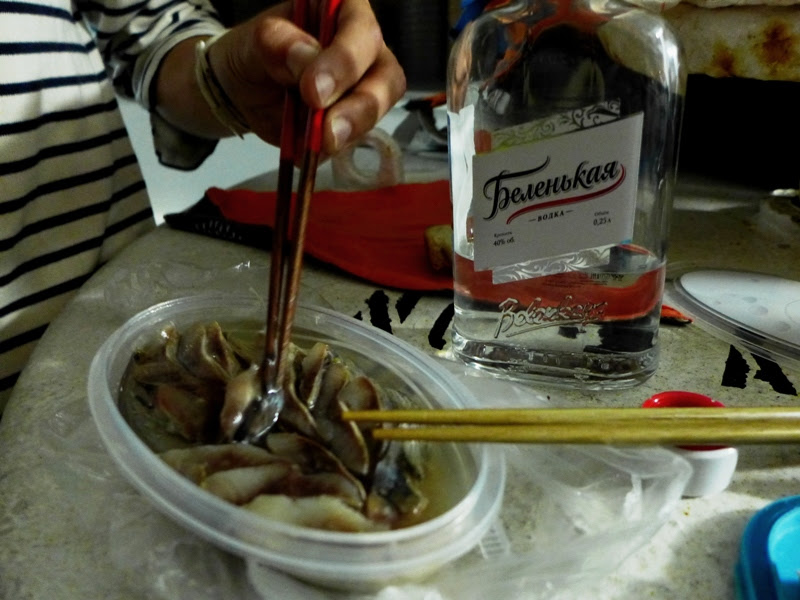
As the sun went down (the rapid tempo of the music fell*), we got the delikatessens out of the backpacks, found a nice spot on the upper deck, and by the time we were ready for our little romantic picnic/dinner, the moon - as full as can be - showed up on the other side of the boat. Our simple but very typically Russian menu was: fresh cucumber and smoked fish on brown organic bread. And of course, a bootleg flask of Vodka, which is actually if not cheaper than, at least as inexpensive as water in the country we had just left. It was our second go with vodka, after being invited on the train by Michail and Mr. James Bond's bad guy with gold teeth. Not that we don't like alcohol but... the experience of the methanol flowing in our system and the feeling we were progressively getting blind, deaf and mad all at once led us to wait and observe ourselves for some days. Ha ha ha! When we realized the night ride on this love boat would actually be lit by the full moon, we decided to give Vodka a second try and didn't regret it: it was lovely and warm, gently caressed our throats and eased the smoked fish and brown bread find their way down to the stomach. The fresh night breeze, the darkness of the skies and the moist from the ocean on the upper deck became some sort of blurry (Eastern) Dream-like experience. I guess you could say my faith was strong but I needed proof, and, you know, when I saw her bathing on the roof, well, her beauty in the moonlight overthrew me and such (but she didn't get to tie me to a kitchen chair nor to cut my hair, although that was part of the plan because it was getting way too long and messy; that would have to wait a little longer). So after watching the moon over the sea, the sea under the moon and the (love) boat rolling in between, we eventually reckoned we were drunk, stumbled back to the bunks and crashed there happy as partridges**.

smoked fish in oil with some vodka; full moon over the ocean wifh shome vodka; ghe nigth breezhe wifg shome womka; zhe jhlj... zzzzz!
With absolutely no sign of hangover and the vivid memories of night-long colourful (Eastern) Dreams, we woke up early to discover the Korean coastline was close enough to be seen, the day was beautiful and it looked like we were to land soon. We both took some time to try the boat's spa before (or after) the crowd. It was an Asian-style collective open bathroom with hot tubs and a sauna, what Japanese would call a sentou (public bath) rather than an actual onsen (hot spring) but: Hey! Where do you get a natural hot spring from on a ferry? It was, indeed, a bit bizarre to relax in a hot tub on a boat, with a view to the open sea, in the middle of eight or ten naked Korean old men, being the only Westerner and wearing long hair and a beard. But I'd better get used to it fast and smooth here, because the situation would probably happen again and again in the months to come...

what do you call a nice cliché: "Asia, land of contrasts", a.k.a waiting in colourama.
After a while, the ferry headed towards what had to be Donghae, South Korea. "Right on time", we thought. Then, we entered the port in ridiculously slow motion, then spent at least an hour getting the stuff anchored and the stairs set up and such, Another hour or so waiting for everybody to land, from priority, to first and special, to groups, Nationals and privileged. Looked like there was a "crappy backpacker with ultra-low priority" category and we belonged to it. When we finally could say goodbye to the crew, walk down the stair and say hello to South Korea, the line for the customs and immigration was obviously long as an English sunday. We were lucky that some of the young male Russians who spent their trip drinking vodka were so drunk and wasted that they started to shout and argue, dropping their luggage, going in and out the line before us until the immigration officers asked them to turn around and get back on the ship. They resisted for a moment, apparently insulting the officers in Russian, then gave up and left, apparently insulting the officers in Russian. We never knew whether they were going to Japan and only intended to go shight-seeing in Donghae for a few hours, or had just incidentally screwed their whole stay in South Korea right at the border... Not that we cared too much, though. Our turn came, we smiled to the officers, handed our passports, answered their questions with reasonable (if not accurate) informations: "we plan to spend about two-to-three weeks in your beautiful country, for tourism and sight-seeing and we plan to stay at hostels and campgrounds". We might have forgotten to mention our firm intention to do Helpx, stay at some Couchsurfers' and free camp anywhere we'd have a chance to...

in Donghae, waiting to disembark: "there is nothing at the end of patience, Buddhists say, at the end of patience, there is more patience."
Well, in about a minute we passed through immigration, customs and through the gates inside the ferry terminal in Donghae, South Korea. The lady from the tourist office greeted us with a warm welcome in a nice English, showed us the closest ATM and the bus stop and treated us with a map of Donghae. What else could we ask for? An ice-mokaccino, perhaps? It was two o'clock sharp as we walked off the terminal and through the parking lot: a good 38º C under the sun hit us and by the time we reached the bus stop, we were sweating like crazy. No rain, can you imagine? End of August and this was officially our first glimpse of summer! We'd love this country, but that'd be another story!


with love from us to you... a petite douceur from the good old times:


_______________________________


* not that we are particularly big fans of Mr. Springsteen, but sometimes you just have to grab your chance to quote a good old' classic Spanish joke by the horns and acknowledge he knows his trade: "Joder, el Boss ¡qué animado! It goes to show you NEVER can tell...

** as they say in Spanish: not because partridges are renowned as a specially happy species of bird, but most presumably because their Spanish name "perdiz" rhymes with happy: "feliz". Et voilà!


¥$¥$¥$¥$¥$¥$¥$¥$¥$¥$¥$¥$¥$¥$¥$¥$¥$¥$¥$¥$¥$¥$¥$¥$


20 cents per kilo

Our special section (hashtag 20 francs le kilo) for the accounting fans, the (tight) budget-stressed and those who would feel curious about - or attracted by - a plane-less journey. They'll find here and in this order: the truth, all the truth and nothing but the truth (rounded to the euro and with some minor memory lapses, possibly). But on the whole, this is what it costed us :

 - Vladivostok-Donghae: in third-class open bunks, tickets bought online directly from the DBS Cruise website (or from a global ferry booker such as AFerry which charges a small fee but may prove easier to use). It's a 19 hour overnight trip and it's by far NOT the cheapest part of the journey: 380 euros for 2 people.
 - There's a port tax to be paid (in roubles and in cash only!) whenever you intend to leave Vladivostok by sea: it's something like 760 roubles per person, so roughly (1500 r.) 21 euros for the two of us.

So, it sums up to sort of exactly 400 euros for two people: boat + port tax, to get from Russia to South Korea. You can add to this the 900+ r. (about 13 euros) we spent at a supermarket to set a romantic delikatessen picnic/dinner on the deck, under the stars and in the (full) moonlight. <3 <3 <3