Showing posts with label seagulls. Show all posts

Friday, November 25, 2016

the tale of the unknown island* (2 of 3)

If you've missed episode 1, maybe you'd like to give it a go before you keep reading here. You done? Okay, let's go.

holy morning light on a creek along the Sh--- trail.

Day 2 - getting up early (bis):

"We left, unsure of what had just happened. Unsure of what would likely happen afterwards, too. We walked in silence along the dirt road, breathing deeply the scent of the teatrees, all the way down to the littoral road. We headed North with the first light of dawn on the ocean and after a while we got to the crossroads we were looking for, with a rusty tin sign for "our" trailhead: the Sh--- Valley. It was our second day on the Unknown Island and it was just past 6am"

At that point, we decided to stop for breakfast, took our backpacks down and got the Trangia ready. So while the water heats up, we'll explain a little bit of the history of this magical place and of our plan for the next few days: home of a unique transitionnal primary rainforest, this island is probably the most preserved natural area in Japan and one of the richest forests in the world. During the Edo period (1603-1868), a very wise Shogun decided to protect the beautiful specimens of Japanese red-cedars (Cryptomeria japonica) by strictly forbidding cutting trees. People were only allowed to re-cut and collect the trees already fallen on the ground. Period. This probably limited the development of the island, but made it a unique wildlife sanctuary. It also means most of the trees you'll come across on the Unknown Island are at least 4 centuries old and the whole forest grew to a level of biodiversity, richness and density that is seldom witnessed where human activity exists. So, we wanted to go on a pilgrimage, that is to say: we wanted to go whorship the very very very old and sacred trees this place is famous for. Some of them (1000+ years old!) can be found inside an Interpretation Center & Park, for paying tourists to visit. Close to the big hotels on the East coast, it's expensive, crowded and you need to book in advance. Three reasons for us NOT to go. Then, there is the real-life sanctuary: very deep in the heart of the dense forest who inspired Miyazaki's Mononoke Hime, there is a group of 3000+ years old red-cedars. The shortest hike to get there takes about 5-6 hours, plus the way back. You need a taxi or shuttle to get to the trailhead and it's packed with guided groups of tourists doing the roundtrip. Thanks but... no!

the long way up, but you know: long as I can see the light...
Now, according to the very few quality hiking maps available, the Sh--- Valley trail was a long and steep option to connect to the main trail "only" 3-to-4 hours away from the sanctuary and starting very close to the sea, just about 40 minutes walking from our crappy-scary guesthouse. How is that even possible? You'll see, Wallis is the best planner/project manager you can dream of. All you have to do is say "Wallis, we need to find a way to get to the sanctuary without paying for the shuttles, without hiking among the crowds and without having to do wild backcountry camping in this super-clean super-pure super-fragile paradise" and wait. She'll spot the half-abandoned, half-forgotten trail, she'll find and book an ideally-located 20€ guesthouse nearby for the previous night and a free moutain shelter at the other end for the following night! What's still up to you to do then, is to take the lead of the resulting strenuous 10-hour hike on an un(t)raveled trail hauling a 25kg backpack and making sure you don't lose the way and she doesn't lose the faith... Now that you've got the big picture and that we've had plenty of time for our Genmaicha and cookies, we're ready to go. Tighten your boots and take a deep breath!

After the warm-up start and breakfast, the first hour was steep and got us worried: we found an abandoned trail in really poor conditions: difficult to follow, covered in fern, dead branches and moss, as well as extremely wet and slippery. The backpacks were heavy and our progression very slow, stopping often to check the map and the few topologic references - basically, the creeks around us and crest lines above us. But the weather was fine and the temperature nice. The undergrowth was beautiful and changing fast. The overall sensation was of a something dramatically alive. First, alive as in "layers and layers and layers of life stacked on top of each other". But then, alive as a whole: a dense, soft, bright and warm whole. Finally, alive as in "a presence", the awkward, lasting impression of not-being-alone. Like a presence. Not scary yet a that point, but a presence. When our trail merged with what the main branch of the Sh--- valley trail, the path became slightly broader and clearer, but also much less steep. That's when we met, and walked together with, a Japanese girl possibly in her early-thirties, also carrying a big backpack and also going to the sanctuary. We went in silence at more or less the same pace, but without taking the stops at the same time, as she apparently valued to be hiking on her own and not as part of any group, team or party.

multi-layer, dense, deep, green lush of the transitionnal primary rainforest ; inhabited woods with a unique presence ; giant mammoth-tree.
Through a short and steep section, the trail took us to a pass with a stunning viewpoint from a rock terrace, where she said she would stop for lunch. We left her and went on down for another 40 minutes or so, until the end of 'our' Sh--- valley trail, which merged into the "main trail". We had lunch there, seeing how different it was and counting the hikers who passed along: not exactly seagulls** yet but, you know, it was midday and a bit late already for people who intended to get all the way up to the sanctuary then back down to their hotel. People with sneakers and a 25cl bottle in one hand... Well, actually, yes: seagulls! Many things were different on the main trail, though: an ancient railway through an area of forestal exploitation during the first half of the XXth century, it was flat and extremely comfortable to hike - which was much appreciated because our seagulls were just warming-up but we had a good 6 hours in the legs already. The aligned, "young" replanted trees were thin and tall and the undergrowth much scarser, but it allowed for much light and fresh air in.
exhibiting signs of human activity and some old-fashion 'haunted' flavour...
There were also many red-bottomed macaques (Macaca fuscata), sure enough lured by the perspective of easy food and cheap entertainment: big colonies of 20 or more individuals settled by the side or in the middle of the trail, sleeping and grooming each other lazily. They apparently tolerated the hikers and let them go in total indifference, as long as the poor humans kept passing them along without showing the slightest intention to slow down: any attempt to stop or - say - take a picture, ended with the males raising shoulders, showing teeth, screaming and aggressively chasing you. Not funny at all... After an hour or so along the easy trail, things got tricky again: the trail climbed uphill, narrow and uneven. Many tourists were giving up, sitting around and waiting as their guides continued with only the bravest. We took a serious pace, left many behind despite our backpacks, knowing the way was still long: they were getting tired and we were still 'warm'! Then we met our young fellow hiker from the morning, who was happy to see us and to show us the famous and special place standing in front of us: inside the huge stump of a giant tree dead long ago, was a natural 'cave' with a tiny temple and a very picturesque hole. We waited for our turn while eating some dry fruits, then took some due pictures before starting again. This deadtree was a turning point for many more people, as well as the unofficial entry to the sanctuary: as the ranks of hikers were depleting, the size of the trees was increasing. The trunks around us were becoming impressive, the undergrowth of ferns and moss was growing again in depth and colour intensity... Over the next hour, we'd see our first few 1000+ years old red-cedars!

the cave, the temple and "our friend" inside the giant stump ; our first big big tree ; the loveable hole and ; some strange fruits...
It was close to 4pm when the light changed suddenly. It faded and became warmer. The very few people we still met were coming down and back (and were a bit f---ed, if you want my humble opinion, as they were the last seagulls and their way back to the coast was longer than the hours of light left). Nobody was climbing up but the girl and the two of us. And the magic happened: there was this warm light and all the moist in suspension in the air vibrating like a cocoon around us. The colours were incredibly intense, vivid. The beauty of every single leaf, of every mushroom, was magnified, making everything more real, more alive. Life was pulsating everywhere around and it was impossible not to feel a part of it all: the sounds of the birds and insects, the breeze touching our skins, the perfect patterns of the intertwined lianas and roots - like some Leonard Cohen written in organic matter. Allelujah! It was a mystical experience. It was beautiful and blissful. The closest to tripping on acid, but without the acid. Maybe we humans lost sensitivity long ago, but that was the "normal" esthetic extasis of experiencing a deep connection with Nature? Maybe such a high dosage of Nature is the only way to re-connect and feel this? Or maybe you were just extremely tired and hypoglycemic, you damn' tree-hugging hippie! Now, according to Mr. Huxley, that's pretty much the same.

the Holy Moment, caught in pictures: magical light under the trees ; one of our first massive cedars ; a colony of friendly 'Miyazaki style' shrooms.
We finally got to the first 1000+ years old red-cedar. It was so big there was no way we could take a damn photograph. It was so big we couldn't even look at it properly, because it wouldn't fit in our limited, unperfect visual field. You would never ever hug a tree like that. You wouldn't touch it. Never would need to. What hugging a regular tree would cause you to feel, such a tree could induce from meters away! Back to where you belong - and beyond - in less than a second, human being. And this was not meant to be offensive, just strikingly intense. Looking a that tree, I couldn't help thinking on a 1000 year scale: WW2 ; WW1 ; Napoleonic wars ; slave trade ; great plague ; conquest of the Americas ; Inquisition ; wars of religion ; crusades... only to name the Western European burden. This tree was so remote it was somewhat separate from humanity, but within its lifespan there was so much it had witnessed of human kind, of our miserable and bloody mess.

if it makes any sense at all, a picture of a 3000 y-o tree.
At the same time and to be fair, it was not judgemental at all. It was, indeed, unconditionnally loving and nurturing: its bark was home for communities, there were entire cities under the surface of its skin, whole countries at its feet and systems of continents slowly moving along its branches. Before we realized it, there was the sanctuary: after this first tree, a second one came in a matter of minutes. Even bigger. Then a couple more, which were called 'the husband and wife'. A sign in Japanese and English explained that about 400 years ago, they had merged through a major branch, 8 meters above the ground and were now connected. Why? How? What for? Pointless questions: because they did. The light was getting dim, we didn't have much time left. Nobody was talking. Nobody was thinking of the destination, the camp, dinner. All mental noise was gone. Just sounds. Birds, insects, the breeze. We kept walking like in a dream, so absolutely tired and overwhelmed - in a state of shock. We passed a fifth tree: thicker, older, grey. Huge. Images of over 1000 years ago: the Alhambra, the gothic cathedrals, Angkor Wat...Then - finally? - we got to a large set of wooden stairs, climbing all the way to a big terrace: in front of us stood the  Y--- S---, the patriarch, the silverback. 27 meters of circonference at its base, about 6 meters in diameter. Not even an impressive figure. It was so humbly beyond figures. The scientists gave him about 2600 years, the legend over 3000. Again, same flow of parasite thoughts, only on a bigger scale even: the Romans ; Jesus ; the very concept of BC ; the Greeks ; wait a minute, Buddha? The carvings of its bark would be as old as some Sumerian cuneiform scripts. How was that already? Like some Leonard Cohen written in organic matter. Enough vain thinking, we came back to seeing, feeling, experiencing. Felt ridiculously small and meaningless. Felt insanely priviledged to be there. Felt like crying. Felt cold and exhausted. We suddenly noticed a party of three was there, in a silent conversation with it, too. At some point we all left together, the six of us, with the last beam of light. We hiked the last 10 minutes to the Sh--- Hut, the nearby free-access mountain shelter. Another great priviledge for a handful of insignificant, random human beings. It was past 7pm: it got dark immediately and the air was cold under the trees.


Night 2 - sleeping tight:

After checking there was still some room left (three spots were free on the ground floor inside - the higher, warmer spots were all occupied already!), we spread our mattresses and sleeping bags before going back to the wooden platform in front of the shelter. Outside, we changed our clothes for some clean, dry, warm ones and hung the wet ones to the night breeze. Our "friend" had escaped the company of humans putting up her tent 20 meters away and disappearing inside right away. We respected that she valued being on her own and at the same time, appreciated the silent communion with the other people: this natural proximity of individuals who realize the gift they share.

the Sh--- Hut, aka the coolest, cardboard, sustainable, upcycled mountain shelter ever!

We cooked in silence and had a quick dinner, seeing how the party of three was in fact a very young mountain guide taking care of his couple of clients: taking all kind of stuff from his backack, he was cooking a romantic and gorgeous sukiyaki for them, while showing them some videos about the Unknown Island on his tablet: 5* service! After over 10 hours of a demanding hike, about 2000 meters of cumulated elevation gain, hauling heavy backpacks and witnessing the most strikingly beautiful and intense wilderness in our entire lives, we could say we were drained, worn out, exhausted and deserved to rest a little bit...

That was Day 2 and at about 9pm, we were sleeping!

To be continued...


___________________________


* Any resemblance to a short story written in Potuguese by Jose Saramago was on purpose and is an invitation to (re)discover this lovely little new classic!


** About the "seagulls": it's a concept of ours (even though many hikers know them too), that we love. Seagulls apparently exist on all continents. Seagulls never fly too far from the coast. So when sailors see some seagulls, they know land is close. Well the same happens on hiking trails in the mountain: there are those people whostart at 11 or 12 or even at 3pm. They wear Converse sneakers or flipflops, carry no backpacks, walk around with just a small water bottle in their hand, with a French Bouledogue or a bowling bag under their shoulder. You usually meet them while you're coming down and they definitely mean you're very close to the trailhead! THey even have their own tag on this blog...


Sunday, September 25, 2016

even farther than beyond! (2 of 8)

more un(t)raveling around Tokyo

 after a short (and wet) night, morning Wallis on the crest trail up to Mont Tonodake.
For those of you who want to practice some Spanish and learn about our arrival and first days in Japan, magnificently hosted in Tokyo by our friend Hiro-san, you can follow this link. For the others, here are some actual, non-fictional, real-life, "everyday" stories (as usual). And for those who randomly clicked their way here, but quite don't know how - and didn't really want to hear about us at all in the first place, welcome, feel free to read on as much as you wish, go back to the beginning of this adventure, to the beginning of the whole thing, or at least check the pics!

This being said, we can start right where we left it in the previous episode: with some of our stuff stored at Hiro-san's and two light-ish backpacks, we went on a circular adventure around Tokyo. With a local train of the Sagami line, we first headed to Shibusawa then went until the end of a tiny local bus line, to a nice little village in the middle of nowhere at the foot of the Tanzawa mountain range. We wanted to get to the Tonodake and Tanzawa summits, both holy, both the goal of ancient Shinto pilgrimages and both renowned for their stunning views on Fuji-san. Concerned by the heat, we decided to take a nap, rest the whole afternoon and evening under the shade of some trees by a river, and wait until the night to do the 5-hour hike up. In this narrow time window of farniente, Futuna finally decided it was time for him to get rid of his hair and beard : people in South Korea and Japan kept staring at him as though they'd just seen a devil or an absolute freak wandering wild and threatening their organized, neat everyday routines... On the subway, along the road, at the convenience stores : everywhere we went, they'd look at him awkwardly with a mixture of fear and disregard. Sometimes though, "a man has to do what a man has to do" (as John Rambo once said), and so we did. Below are the evidence, the from-before-to-after-all-through process and the result shown in colour pictures:

Futuna before (old boy-looking scary freak), during, during, during, during and... after the ritual shearing ceremony (no poodle was hurt) !

Yeah! That felt much better (and much lighter!) without the fluffy being we philornithically donated for the birds to insulate their nests before winter. Bio-construction knows no borders! Our initial idea was to hike at night all the way up to the mountain refuge below the summit, set a bivouac up there and wake up early to go see the sunrise on Fuji-san from the top... The evening passed slowly and as the light started to fade, we had a warm dinner of instant noodles and miso soup. We took the backpacks, took the headlamps and took the clear trail up the woods. With the night came some fresh breeze and many animal sounds responding to one another in the darkness of the forest. The moon followed us high up, sailing silently through the trees and making the halos of the headlamps barely unnecessary.

"how to deal with your leech issues: a guide for functional analphabets".
We met a late bird classic seagull coming back to the village in sneakers and shorts, with no lamp but a small (empty) bottle of water... Thanks to a successful advocacy campaign, we now knew enough about the deadly vampire-toothed leeches waiting for us at each and every step not to fell in their trap. And - although very graphically - also knew how to deal with those who'd make it to our legs anyway. On we went. We walked fast and soon passed two refuges with people having dinner and listening to the radio inside. Headlamps off, trying not be spotted nor heard - as though they were to force us in for a warm soup and tea! As we progressively lost both the additional supply of the moon and the shelter of the trees, we started to realize the weather had changed the wrong way : the low gray clouds started to rain on us as we got off the forest and along a ridge leading to a third refuge. The intended bivouac was becoming increasingly unlikely... Under a thin and cold rain, we set shelter between/under two wooden picnic tables we paired on the terrace in front of the (closed and tight-locked) refuge. The night was long, windy, wet and sleepless, but the sun woke us up nicely and we decided to go straight up to the summit of Tonodake to enjoy the views and have our breakfast facing gorgeous Fuji-san in the magnificent beauty of dawn's light... When we reached the summit, we found another refuge at the very top, whose staff were drilling and screwing a wooden porch like crazy before the weekend's crowds arrived. And, as for the impressive and harmonious figure of the emblematic volcano, well, this:

hiking long hours, unsleeping under the rain, checking the horizon, searching Fuji-san: can you spot it on the second picture?
Our breakfast was nice enough anyway, and as the first couple of early hikers arrived, we decided it was time to go back down and enjoy another train ride beach-bound: urged by the need for a shower and lured by the image of a midday swim in the sea, we took the backpacks and left. The trail looked somehow different with daylight: the kilometers of fully-equipped wooden platforms, stairs and footbridges now seemed even less necessary than the night before! Not much to fear from the terrain, not much to protect us from - except, maybe, the herds of vampire-toothed leeches hidden in the moist soil. On our way down, we crossed many (like very very many!) local hikers going up, sweating their a--es off along the steep steps, but shining in bright clothes and brand-new gear. Most of them were looking at us with a mixture of pity (for our ridiculously heavy loads), surprise (to be meeting gaijins there) and some sort of... annoyance? bitterness? jealousy? over-heat? A little bit of each, probably. Let's call it the seagull's complaint.

the long way down (and up) along the anti-leech footbridge across the woods...
Their incredulous looks meant something we understood like "how come these gaijins with such miserable outfits and such big backpacks are already hiking their way down at such an early hour of the day, while we locals are hardly in the first half of the hike?" The feeling they transmitted was like: "How dare you?", but a very educated and polite "how dare you?", disguised with just a little bit too much smiling and hand-waving. Nothing a big ear-to-ear gaijin smile and a solemn "ohaiou-gozaimassss", with an excessively long sssss, couldn't solve. Down we went, passed the two refuges and a spring we had missed in the dark just fifteen hours earlier or so. We got back to the trail head and were lucky not to require the saltbox. We took some time for an instant coffee with milk and a nap with an old cat before getting on the bus back to the station, then on a series of local trains to Kamakura: a fancy, famous, touristy (and quite posh) beach town. For our Fwench readers (and maybe the Britons as well), Kamakura is some kind of Tokyo's Deauville, cabins included but with no international movie festival (yet). The Belgians and other Brel-ists could also use a sensible comparison with Knokke-le-Zoute, mainly for the invasive seaweed and crowded lines of cabins. Kamakura, we learnt, was also quite famous for its big big buddha: allegedly the biggest sitting Buddha in Japan. As most of you probably know already, each and every Buddha in any country is the something-est Buddha in a certain amount of space. If we had a Buddha in the garden, we sure enough could state it were "the lamest Buddha in the whole Ariège", or "the lightest wooden Buddha of all cities beginning with a T." - just to name two of the many titles available. Anyway... In Kamakura, we intended to see some temples, the beautiful botanical garden, the giant sitting Buddha and, well, the beach. All this, we did and it was well worth it, nice and easy. After all, sightseeing around traveled places is NOT a crime, even for two amateur un(t)ravelers!

bamboos, green and old stairs in Kamakura's park ; more bamboos, cave temple and a litter of hinari foxes ; the one and only surfers' paradise!
It was, after all, just a matter of walking kilometers with our stuff, enjoying the views, the sun and the sea. We also intended to camp one or two nights around town, confident that, this time, the weather would be indulgent/nice/fair. Alas, poor Yorick (and Futuna)! This we didn't and it was really (to quote Tina Turner) nice, but rough. Again that night, the rain found us hidden somewhere by the beach, followed us along some desert streets and chased us deep inside Kamakura's park. There, after a technical stop at some remote restrooms where we cooked dinner, showered and changed clothes, we found a secret little shelter and slept dry until the first jogger and gardener passed by shortly after 6 am (!!!). We packed and left without looking behind, headed back to the beach for a yummy breakfast, then sun-dried some clothes while we had this long-deserved and long-expected bath in the fresh waters of the Sagami bay. Nice!

"shabu-shabu", another of Japan's cuisine best kept secrets!
We also made sure to visit the giant Buddha, of course. It was, indeed, a big one. Maybe not so big. But quite big already. A great Buddha, really. One of the best Buddhas in the country, for sure*. And when it became crystal clear that the rain was going nowhere and spending another night wild-camping (and slightly unlawfully, or at least in a grey zone of legal void on outdoor sleeping in urban areas) was not a reasonable option anymore, we got on a train and returned to Tokyo, where Hiro-san and his girlfriend Hana-san treated us upon arrival with a gorgeous and dangerously yummy "shabu-shabu". Not among the most famous Japanese dishes, shabu-shabu is an under-rated wonder: some kind of fondue or sukiyaki, where thin pieces of meat, shrooms and vegetables are cooked in a katsuobushi** broth. The dinner was amazing, Hiro-san and Hana-san's company just great, as usual, and the whole situation of being back in Tokyo and being received with such a warm welcome even though it was just... 4 days after leaving (!!) made us so very happy the trauma from this latest episode of rainy bivouac healed right away. The next morning, and after a short but dry and comfortable night, we were ready to start exploring Tokyo again for another couple of days. But that's gonna be a next chapter and that's gonna be within a few days... For now, back to the yummy-ssimo shabu-shabu, whose name is supposed to represent the sound of the thin pieces of meat you dip in the boiling broth. "Shabu-shabu", do the pieces of meat in the hot liquid just before you swallow them slurping and touching the sky: Oh! the dishes you'll eat... Another wonder (last but not least!) about this amazing recipe is that, once everybody has eaten enough seaweed, meat and veggies, the remaining (used) broth is heated again and serves to cook a wok-ful of rice. Oh! The rices you'll cook... We went to bed stuffed, exhausted and super thankful. The latter, we still are: thank you so much Hiro-san!


___________________________


* About the ---est Buddhas in Japan: there's a very very famous one in Nara. If our sources and memory can be relied on, Nara's is supposed to be the biggest WOODEN Buddha in Japan ; whereas the black Buddha in a temple in Tokyo's northern suburbs (make sure to check our next episode if you happen to be curious about this topic!) is allegedly the biggest STONE Buddha in Japan. Kamaura's is, we already said it, the biggest SITTING Buddha in Japan, which implies there must be a biggest RECLINING one somewhere in the country. An un(t)raveling unicum postcard will be sent to the person who'll provide evidence on the biggest reclining Buddha in Japan in the comments below!
About the katsuo-bushi: it's been introduced and talked about enough in the previous chapter, but feel free to ask anything you need/want to on this topic anyway... I personally feel sorry that I might not be factual enough about Japan, but I'm dealing with this issue. I'm fine, thanks! Really...

Friday, September 9, 2016

Beyond the end of the world (3 of 5)

making South Korea smaller, one bus at a time!

average South Korea window view: neon signs, foresty hills and... a fake waterfall!
It's not a mere coincidence if this -among so many other things- was the first (and to the date, sure enough the main, even though "finding a decent place to free camp" was in the shortlist too) of the several SKCs (South Korean Challenges) we took on. South Korea is indeed a relatively small country and, if something can make it even smaller, it's its fantastic, cheap, dense, anastomotic intercity bus network. It usually connects one intacity bas talminal to another intacity bas talminal, where you'll always find a vending machine with the cheapest coffee with milk, free wi-fi and an air-cond waiting room so your body won't notice it's actually 38 ºC outside! Neat. The bus companies operate everyday from early morning til late at night, but not so often overnight. As far as we understood, the only reason why there are so few overnight coaches is the size of the country: it's so small it wouldn't make any sense at all. Voilà: touché! At first, it seemed you could go from any city/town to any other city/town with either one direct bus or a couple of transfers. And it looked cheap, considering how easy and smooth it was to get from one place to another. We said "at first", because at some point, we became over-confident, forgot all prudence and got so deep inside the rural country that coming back to civilization was suddenly a seven-hour marathon of tiny local buses with no time-tables, no maps and not a single word of information written in Latin alphabet!
map of South Korea provided by G----e, showing our wanderings and bus-hoppings,
from arrival (Vladivostok, Russia) to departure (Osaka, Japan).

Free wi-fi also appeared to be correlated with Latin alphabet and it was more than a mere trend: they always disappeared together! It was supposedly easy to get a SIM card either to give/receive calls or to just access the internet, but we were told by some informed friends the wi-fi offer was plentiful and it was unnecessary to pay for a SIM card, be it very cheap. Which was generally true. Well... The time has now arrived to ruin every little bit of surprise and suspense, showing the full monty and revealing most of our movement across the gorgeous little green peninsula: right there is a map you can look at in order to get a fair idea of where we got in, through and out of South Korea.

- Donghae and Gangneung: we talked about these two cities by the sea in our first South Korean post in B major: beach, bus and bivy.

- Seoraksan National Park: we told you as much as we could about the Asian doppelganger of Catalonian Montserrat in this other post, with pictures in colours to lure and inspire our climber fellows who may be getting there someday...

- Chiaksan National Park: we got there through a never-ending series of bus hopping under an end-of-the-world sun, cruising through Korean small towns (understand: ranging from 120 to 160 thousand inhabitants) and eventually landing in the evening on a hot dirt patch with no shade at all. The landscapes and views from the bus windows were really nice all day long: sloppy hills covered with forest, taller mountains in the background and flat valley bottoms with rice fields packed around quiet rivers; just the average "small town" surrounded by huge blocks every now and then.

the long way up: no stairway to heaven, no highway to hell, just patiently stair-ing, sweating, and swearing up to the top...
The next morning, we hiked up and down one thousand stairs to summit Birobong, the highest yet slightly frustrating (1300m asl) peak to be found around. We climbed our way up the metal staircases only to discover a power-generator buzzing, all kind of power tools blasting, grinding, cutting, sawing, drilling, sanding and welding around, all operated by a happy team of villagepeople-ish tough guys building a huge metal-and-wood platform around the giant, ancient and supposedly iconic cairn (a pile of stone, in mountain slang) which apparently was the ultimate goal and reward for Birobong’s brave conquerors. Let's face it: high season was over, the camping was almost desert and it was probably the best time of the year to build that, regardless of the handful of disappointed and sweaty hikers who made it there, namely: us. Anyway, the cairn was worth it.
the peaceful and iconic summit of Mt. Birobong, low-season-maintenance style!
We went back to our spot, had some instant noodles and a solar shower of ours, then a long nap by the river*. We got to cook some local zucchini and “shrimp sausage” (it's not as bad as it sounds, honestly!) risotto on the Trangia. Around our tiny tent and heavy backpacks were the last few families of the summer: their huge Hyundai and Kia SUVs parked right in front of their huge Coleman tents with rooms, kitchens, hammocks, fans and furniture. Sometimes, they would look at us and smile awkwardly, both because Westerners didn’t seem to make it there too often and because we looked so poorly-equipped and ill-prepared. Not only at the campground, but also on the trails: no energy belts with glucose shots, no camelbacks, no sticks, no thermal-breathable-intelligent softshells, no fancy-shiny-tiny trail boots... Unlike what many people say, the national sport here is not exactly hiking. Apparently, car-camping is. And it comes as a package with buying and wearing expensive, unnecessarily technical mountaineering gear to just walk around between a whole three-course picnic and teatime. In un(t)raveling dialect, we call'em seagulls**.

raindrops keep fallin' on our heads,
and just like two guys whose gear is too big for their tent...
to make it short: don't worry, be happy!
As you would expect, the heavy evening sun gave place to a stormy night with pouring rain. Again, we had to abandon our tiny tent and seek shelter somewhere more water-proof, like the bathroom porch. Our neighbours apparently considered it such an unbearable invasion of the collective premises that - without a word nor the slightest sense of compassion towards us (taking into account their many tents' spare square meters) - they asked the campground's guard to take us out of there. He came, very very sorry and ashamed, to check what our options were. After seeing our tent, he installed us in one of the bungalows for rent (all empty at this time of the year), only insisting on the fact that we'd have to wake up early the next morning. We did exactly that: shortly after 8am, a local bus full of school boys and girls in uniforms dropped us back at the closest citybas telminal, ready for our next destination:

- Andong (cultural heritage): after another day-dreaming ride on another local bus, we ended up in Andong downtown. We both equally and urgently needed to get some clothes clean and dry, to get a warm and thorough shower, to get some decent sleep on a dry and comfy mattress. In a word: to get to a hotel. After the camping days (you pay for a spot, regardless of the number of people in your party, of whether you have a car, of the size of your tent and such... making campgrounds substantially more expensive for us than they usually are in Europe), our travel budget allowed for little more than "not much". The (only?) one and good option was, of course, to spot and book a love hotel!***

room dining at a love hotel: some clean sheets, gorgeous street market food and
THE cheap-chic detail of the anti-stain, glittery-purple, vinyl stool...
Even in an old town full of history and culture, "walk down the right back alley and you can find anything". Indeed, passed the train station one particular street was packed with car parks hidden behind purple velvet curtains, with blue neon signs advertising such unambiguous places as the dark pink "romance hotel", the Las Vegas inspired "dollar motel" or the classy/trashy "hotel Q"... At a love hotel, you seemingly get more for your money: tons of free samples of almost anything you can imagine, from shoeshine to grilled peanuts, toothpaste, toothpicks or lube. Amazing. And you probably should add: hairdryer, microwave, kettle, multiple fans, a generous offer of cable TV and pay-to-watch "adult" channels, way too many mirrors and the mandatory UV sterilizer to ensure surgical grade-safety while doing whatever your imagination urges you to... Customers usually crave for privacy and a low-profile setting, hence the many curtains, cars' plate covers, dark corridors and even a front desk with nobody but a vending machine spitting the key of your desired room as it'd spit a Twix or a can of diet Coke. Oh, the places you'll go!

in this specific order: old fossils; old school; old masks; old wood; old rusty thing; old mafia house and oldest-brick-pagoda-in-the-country!  
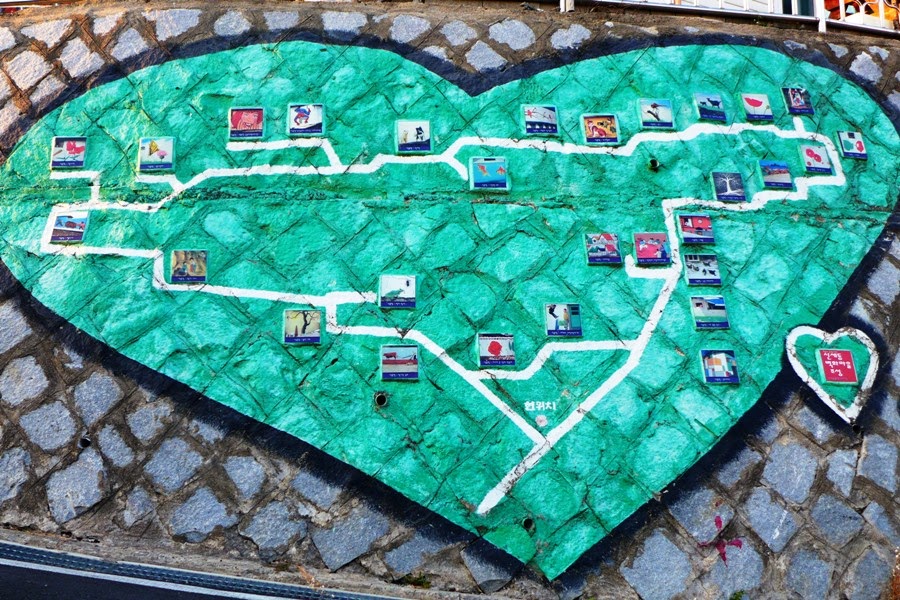
Before the evening was over, we went for a walk around town, to an old pagoda the oldest brick pagoda in South Korea and an old house the adjacent, gorgeous mansion of the local mafia a famous, ancient clan dating back to the three kingdom era. Wandering around along the river bank, we hit several antique boutiques, flea, thrift and vintage shops, a couple of temples and some beautiful old workshops, kept dusty and dans leur jus by some authentic, picturesque, white-bearded craftsmen. After a while, we randomly hiked uphill to a small neighbourhood whose narrow streets had been taken up by the locals' vibrant creativity: all the painted houses made it look like a giant open-air comic strip. The colours were warm in the sunset light, almost as warm as the teethless smiles some old ladies greeted us with, proudly sitting on a bench in the middle of their collective chef d'oeuvre with a petit air de "We invented street art, kids. What did YOU invent?". Below is a (non exhaustive) small collage of some of our favourites:

I'm painting my house, in the colourful way. And when my mind is wandering, there I will gooooo

After a beautiful sunset on a pond with frogs and a cheap/chic, classy/trashy night at the love hotel, we were out early the next morning, to get on a new series of buses southbound, to:

if you want to see Futuna hysterically jump and scream, the only thing you have to
do is to make sure he inadvertently (almost) steps on one of those creepin' fellows
.
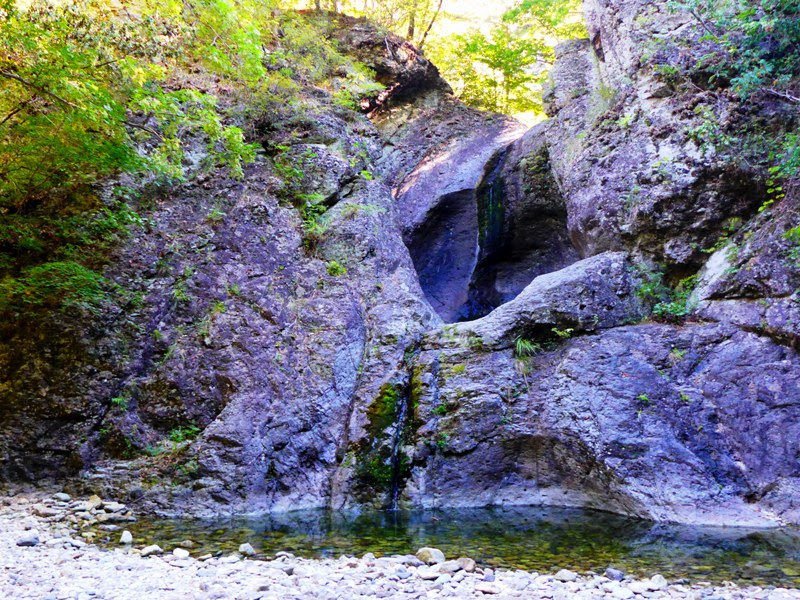
- Juwangsan National Park: our experience of this third national park was highly enjoyable, thanks to some new friends we made (see one caught on picture here), to the rain which gave us a two-day break and to the very features of the place: insane sun and heat, a pitch with no shade, a group of young, friendly, beer-enthusiast German hikers as neighbours and a very picturesque landscape. We slept under the stars, with nothing but un peu d'essence de Guerlain dans les cheveux (ou presque) and a mosquito net. We then woke up early and took the trail to several renowned waterfalls, which we were a bit disappointed to find waterless. Apparently, the unusually hot and dry august took them by surprise and, you know, there was not a drop of water to be seen around. We considered it to be an effect of global warming, but it could as well be just another scam for tourists: water might have been long gone and the place would still be luring crowds of camera-bearing, North Face-wearing, breathtaking view-hunting individuals. The question was: who knew? No, the question was: who cared? The rock formations around -caves, canyons, cliffs and boulders- were beautiful and the scarce water running here and there was green and mossy. Legions of signs clearly indicated bathing (not a single sane person would have considered it) wasn't allowed. Not only was the rescue gear always at see, engaging into many other nice activities was forbidden as well.
the would-be official Juwangsan postcard, if there happened to be one.

After a few dry waterfalls, caves and temples, Wallis decided to take a rest, reading her book hiding from the sun by a temple, while Futuna had his little Kilian Jornet moment, running/hiking to the summit of one of the small nearby mountains/hills.  He came back sweaty and out of breath, having witnessed the beauty of Juwangsan from above and taken way too many pictures of the whole ascent. Just before reaching the campground, we walked through what was a desert alley to the temple a few hours earlier, only to discover a busy and beautiful market of medicinal stuff, roots and herbs. Probably for tourists craving for green magic, ground shrooms and other dry phyto-healing. Well worth a couple more pictures, indeed. The weather was still sunny but the forecast kept announcing a typhoon we both expected with concern: rain? again? really? We decided to go on southbound on our way to Busan and looked for an option to keep camping dry and warm. While trying to fit in a busy and ever-changing CS host's agenda to make it to another National Park, we stumbled on the limits of intacity bases and had to change plans (Jirisan, apparently beautiful. Consider renting a car to get there...). But before we leave the area and à la demande générale, here is a photographic summary of our little Juwangsan tour:

forbidden to forbid? not in this country apparently: don't be clumsy, don't climb, don't drown and in case you do anyway, here's a good buoy! 
(hardly) shored rock ; what(er) the fall is this? ; crossing the bridge ; stone Buddha ; what(er) the fall? #2 ; piles of stones ; Wallis' holy moment.
"au marché de Brive-la-Gaillarde, à propos de bottes d'oignons, quelques dziaines de gaillardes, se crêpaient un jour le chignon..."

We fell in the trap of another allegedly amazing-free-campsite-by-the-sea and thougt it'd be good to rest on the beach and sunbathe for a couple of days. And that's how we finally met your mo got to Geyongju - probably the one most beautiful, authentic, richest and tastiest of our South Korean experiences... And that's probably more than enough for today: we'll keep this and the rest for the next chapter(s)! Sending y'all lots of love from some South Korean intercity bus terminal, take care and enjoy your weekend!


___________________________


"be river, my friend" - translate: mold onto a comfy bed of rock and rest in the shade of the trees".

* the all-times classic and BruceLee-ly famous "be water, my friend" in an alternate version.

lifting the veil on Clint Anderson's next movie: "Motel dollar, baby?"
** about mountain seagulls: we first observed them years ago in the Pyrenees and Montserrat, before witnessing they were endemic to many other places: the Dolomites and Alps in general, just to start the list. Generally speaking, you can find some anywhere there are mountains. They eventually became a topic (and keyword) on this blog, so you might find a definition in some previous entries.

*** love hotels! they're material for a whole photographic series (Lolo, there's clearly something for you here!) or PhD: apparently a whole culture of extra-conjugal life. Maybe caused by one the highest population density in the world: must be hard to get privacy at home. Who knows? Truth is, love hotels are fascinating and... very convenient! ;)